Where Are They Now? is a series interviewing Returned Peace Corps Volunteers (RPCVs) from Thailand, where Holly Lingenfelter aims to cultivate understanding, excitement, and create connections across time. If you are a Thailand RPCV or know one who would be interested in being interviewed, please contact us at pctm.stickyrice@gmail.com.
Holly Lingenfelter, 136 YinD
Meet Anthony Zola of Group 32

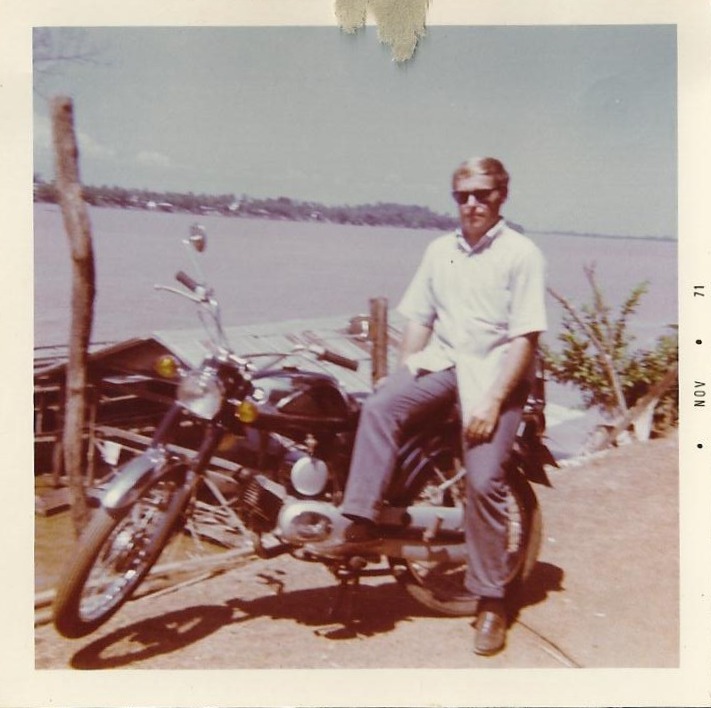
Anthony Zola served as a Community Development Agriculture volunteer from 1970 to 1972, in the province of Nong Khai in the northeastern region of Thailand. Tony’s Thai nickname is Sǒm-boon, which means perfect.
What inspired you to join the Peace Corps in the first place?
“I wanted to be an American ambassador, and the Peace Corps was a stepping stone. I applied for the State Department, I was rejected. I passed the foreign service exam, but they wouldn’t accept me because I was too young and didn’t have experience. I couldn’t join USAID because I had no experience. So the Peace Corps was something to do overseas.”
“If you went to the Peace Corps, you got a deferment for two years. So it was a way to avoid the draft for a while. . But I wasn’t against the war, I was not demonstrating against the war or anything. I knew that I would have to go in eventually. But I said, I want to try to make peace before I make war. And because I had the desire to become an ambassador meant that I was interested in diplomacy. And so why make war? Why can’t we try peace first?”
“I chose Thailand because my political science professor at George Washington University, where I was studying in Washington, D.C., had us read a book on American foreign policy. And the closing chapter of the book said the Americans should not be dropping bombs and killing people in Vietnam. We should be trying to win the hearts and minds of people in countries like Thailand so it doesn’t fall into communism. So I came to Thailand to save it from communism.”
What was your primary assignment or project during your service?
“I was working with Thai Government Community Development officers promoting agriculture at the village level, and the government was trying to get villagers to raise chickens, hybrid chickens. So my job was to train the villagers to grow chickens. I was born and raised on a dairy farm near Buffalo, New York. I was in 4-H, and I was involved in all sorts of agriculture stuff.”
“I got to do everything, raise chickens, and grow gardens. I introduced all sorts of American and European vegetables, like bell peppers, potatoes, and asparagus. Because in Udon Thani, there was Air America, and the American military were buying all this stuff, and they’re having to bring it in from overseas. Plus, in Laos, across the Mekong River, one kilometer from where I was helping my villagers, were the French, Russians, and Americans in Vientiane. So you had this European market all looking for potatoes, green peppers, and asparagus. So I said, why don’t we grow it here? And so we did. I went down to an agricultural college in Chon Buri, where they had introduced asparagus. I had to go by bus, and I had to bring the asparagus in boxes up to Nong Khai and take them to the villagers and teach them to plant each crop. The American ambassador, Leonard Unger, came up and visited my project. It was a model project.”

What was one of the most impactful or memorable experiences from your service?
“I think having come from a very safe community like Western New York, I’d never been through a flood before. So the flood in Nong Khai in 1971 had a big impact on me, number one. Number two, the reason I joined the Peace Corps was to become an ambassador, and then the American ambassador came to visit my project. That made a big impression on me because I actually met a real, live American ambassador. Being from Western New York, you never meet American ambassadors. So that was important to me. I was a simple farm boy from Western New York. I started my undergraduate studies at the New York State College at New Paltz for two years. Then I transferred to George Washington. And I finished at GW only because I wanted to get a better education. That and the Peace Corps opened up the world to me.”
What was it like serving as an American Volunteer in Thailand during the Vietnam War?
“You heard the American bombings, even in Nong Khai and in Nakhon Phanom. You could hear the bombing going on in Laos. It was the American B-52s dropping bombs on the Plain of Jars, which is a couple of hundred kilometers away, but it was loud enough to hear the bombing at night when everything was quiet. You could be in bed and listen to the bombing going on. It was really scary.”
“The United States and Thailand have been close friends since the 1950s. So there was a good feeling between the United States and Thailand, because the Thais realized that communism was real. I mean, they heard the bombing, they saw the people, refugees coming down off the Plain of Jars where their villages were being bombed and where there was fighting going on. And the communists were invading. The North Vietnamese army was invading. The Thai people knew that they needed to save their own country. And they were very diligent about doing it. So the Americans were friends. I was there for technical assistance. My job was to teach farmers how to raise chickens. The modern way of raising chickens under their house, teaching them simple things, and introducing the concept of mixed feed. They raise them for 30 days, and then they sell them, and they make a bunch of money, and that raised their income. So if they’re doing chicken raising, they’re not thinking about being hungry or being poor. And they’re not thinking about when the communists come to the village at night, when I’m not there, they try to brainwash these people. And the people knew better because we were doing good things for them.”
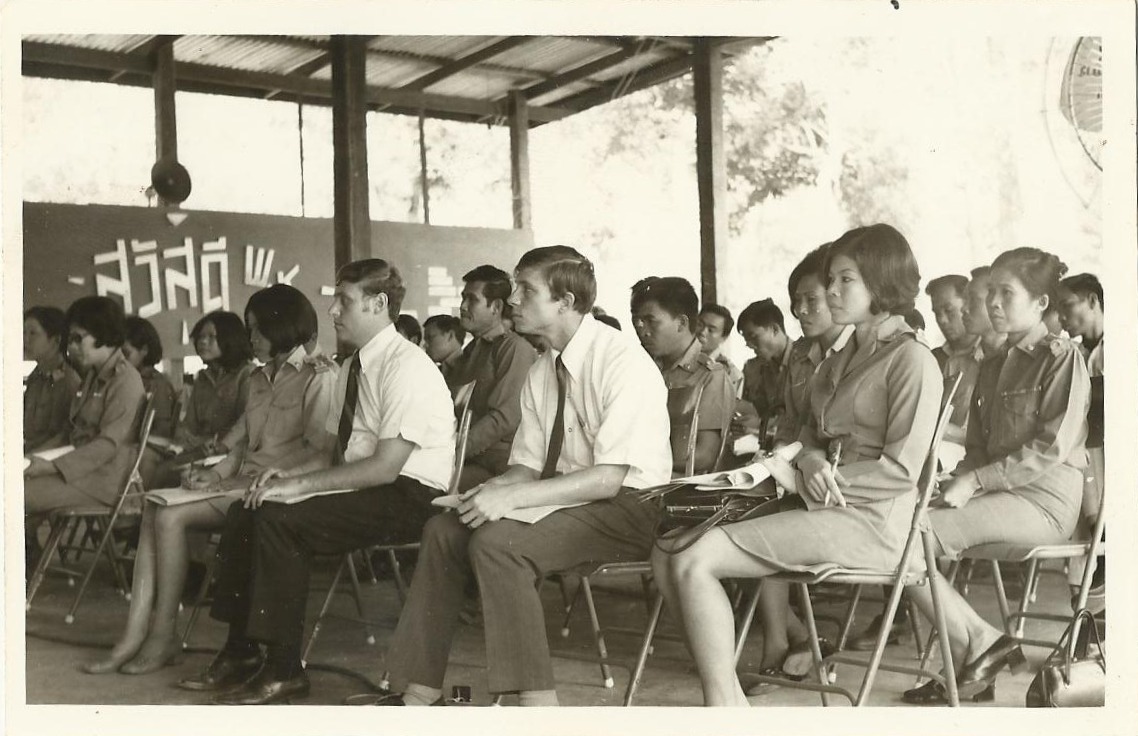
What was your transition like after leaving Thailand and the Peace Corps?
“I was coming to the end of my tour, maybe 3 or 4 weeks from there. A friend, a fellow PCV, who was in Nong Khai, was going to see one of his friends in USAID in Vientiane, across the river from Nong Khai. He couldn’t speak Thai very well, so he asked me to go with him. I told him I don’t want to go, I go over there all the time. I finally said, ok, I’ll go with you. That day, he went to visit his friend, and that afternoon I was hired to work for USAID. I had no intention of applying for a job, I had no idea who he was going to meet with, I didn’t know a thing. So I stayed for 3 more years from 1972 to 1975, until I was evacuated. And then went back to graduate school. I was on the last evacuation flight out of Vientiane when the communists took over in 1975.”
“I finally went back to graduate school after five years in Southeast Asia, and went back to Syracuse University, and studied development economics, because I was so inspired by the Peace Corps plus USAID. So I studied development economics to work in the developing world. That’s why I was doing all this. Eight times I took the foreign service exam. I passed it the first time and failed it seven more times. There’s divine intervention. Obviously, I was not supposed to be in the U.S. State Department, so that’s okay. I’m very happy. I’ve had a wonderful life.”
What kind of work have you done since completing your service?
“After graduate school, I was working for Catholic Relief Services. I took the first job that came up, and they said, oh, you speak French. So off I went to West Africa, in Ouagadougou, now the capital city of Burkina Faso. I was there for just one year, and then the World Bank recruited me to work as a consultant in Thailand. They needed someone to speak Thai. Ah. divine intervention. And where did they send me? They sent me to Surin and Buri Ram, and I worked for the Thai Department of Public Welfare, doing land settlements. Basically, taking Northeastern Thai farmers and resettling them, giving them land, getting them organized, getting them to grow crops, getting them to grow chickens, fish, pigs, and everything. My job was the agribusiness advisor, so I would link the farmers to the markets. That started in 1977.
“And lo and behold, in April 1978, the Cambodians attacked Thailand and burned down my land settlement. Had I been there, I would have been dead. Luckily, it was April 1978, and it was a long weekend. A friend of mine wanted to see his family, and he wanted to introduce me to his wife and kids, who were living in another province. We drove up there, but when we came back after two or three days later, and we went to the petrol station to fill up, they said, you can’t go into the land settlement because it’s been burned down and the Cambodians have attacked.”
“I came back to Thailand, and I worked as a consultant for four years for the World Bank. That was followed by working on a USAID project for an American company called Louis Berger International, spending two years in Sakon Nakhon.”
“In the mid-1980s, I stopped doing consulting work in the field and joined an American company based in Honolulu, called Hawaiian Agronomics. I opened their branch office in Bangkok and ran that for them for a couple of years. Then they asked me to come back and join them as a partner of the company, so I moved back to the United States, to Honolulu. They restructured themselves, and I became their Chief Operating Officer. I had no life. Every 2 weeks I would fly from Honolulu to Fiji in the South Pacific, and then to New Zealand, change planes, go to Singapore, sleep in Singapore, and then follow up on projects that the company was implementing for the Asian Development Bank and the World Bank. Fly to Dhaka, Bangladesh, and then Kathmandu, Nepal, and then Lahore, Pakistan, and then back to Bangkok, where the office was. Then, Bangkok back to Honolulu. I would be on the road for 2 weeks, and then I would not be on the road for 2 weeks.”
“I got tired of traveling, and I said I want my own company. So I ended up buying out the Asia branch of their work, and I moved back to Thailand. I had 23 years of operating a consulting company, I was in charge of a whole lot of people, looking for work and bidding on consulting jobs. We did a lot of work, we did a lot of very good work for the Asian Development Bank, the World Bank, USAID, the Danish government, the Japanese government, and the Swiss government. We had projects in Vietnam, Cambodia, Thailand, Laos, and even in Burma. Then I got old, so I had to stop. When I turned 60 I stopped the company.”
What is the lasting impact your service had on you?
“Treasure your time in the Peace Corps. It’s people, that’s what we’re all about, isn’t it? We’re here on earth to have a positive impact on other people’s lives. And the Peace Corps gives you some of those tools, some of the mechanisms that you need. If you’re wise, if you’re intelligent, and if you’re a well-intentioned person, then it gives you those tools to use to help other people throughout your life. And you can still have a level of living and a style of life that you choose to have.”
What advice would you give to PCVs who are near the end of their service and are unsure about what to do next?
“I do mentoring online to students at George Washington University, at Syracuse University, online with young people who are looking for work in the international area.”
Zola recommends acquiring a Master’s degree after your service, and acquiring your PhD if you’re interested in working for any of the big banks like the World Bank, Asian Development Bank, or the Development Bank of Latin America.
The opportunities for working overseas as an American are disappearing now that the USAID is gone, and it’s increasingly difficult to get into the United Nations. However, Zola states there is still hope. He recommends looking into large philanthropic non-government organizations and looking at where billionaires, like Bill Gates and Warren Buffett, are donating their money. Find the names of those NGO’s and look into working for them.
“It may be difficult for Americans to be hired in certain areas of international work, but there are still sources doing the same work all over the world; you just have to dig a little deeper.”
Where are you now? Geographically, professionally, and personally?
“After I closed the company, I became freelance again, so I’ve been working since 2007 on this social safeguards auditing, which is basically called environmental and social risk management. That means making sure that the people who are impacted by a big project, like hydropower or wind power or a highway project, or something like that, making sure that they have received the entitlements that had been promised to them. That includes everything, housing, schools, health stations, everything you can imagine that goes along with a person’s life. They were promised those things, including what they call livelihood restoration, so that’s where the agriculture comes in again. That’s my real strong point, making sure that the villagers are promoted a livelihood that will restore their income to them, and even get them to do better things. That’s what I’m doing right now.”
“It’s wonderful to close my career doing this kind of work, and such a good feeling, because you’re really helping people while everybody else thinks they’re in the way. We make a real effort; the World Bank and the Asian Development Bank have very strict rules and regulations and safeguards that we have to implement for them. These are huge, enormous projects, and thousands of people get resettled. So my job is to go talk to the villagers. Laos is my second language. I’d been working in Nepal a little bit, Cambodia a couple of times, on this kind of stuff, but my strong point is Laos. The contracts are long-term. One project started in 2007, and it ended in 2018. Another project started in 2008 and ended in 2024, and 2 more projects started in 2012 and they’re still going. I have 1 project that will take me until I’m 99 years old.”
Zola currently lives in Thailand, outside of Bangkok. He is an American Citizens Liaison Volunteer for the American Embassy, and acts as the link between Americans and the Embassy, helping those in trouble by linking them to the Embassy resources for assistance.
“It all started with the Peace Corps. Everything I am, it traces itself right back there. The fact that I took the foreign service exam and then could never pass it again, and couldn’t get into the foreign service, and then Peace Corps set the foundation for me to build on, to do the stuff I’m even doing today. In October, it’ll be 55 years since I joined the Peace Corps in Thailand.”



 Sticky Rice
Leave a reply to paquettepaul Cancel reply