
Emily Hoffmeister, 135 YinD
How We Met
I first met Bright when I was a junior in college and he was a freshman. As I passed through the dining hall one day, I heard a curated playlist blasting from the noodle station—rap, reggaeton, and other crowd-pleasing beats. Bright, a student worker at the time, was behind the music. I didn’t know much about him, but I knew he had excellent taste.
The following year, I learned Bright was an exchange student from Thailand. When I received my Peace Corps placement for Thailand, I reached out for advice—only to discover that he had grown up with a Peace Corps Volunteer in his school. Since then, we’ve stayed in touch, sharing cultural insights and even reconnecting in Bangkok during his spring break. I recently interviewed Bright to highlight his unique experience growing up in rural Thailand and his relationship with the Peace Corps. Here’s what he had to say.
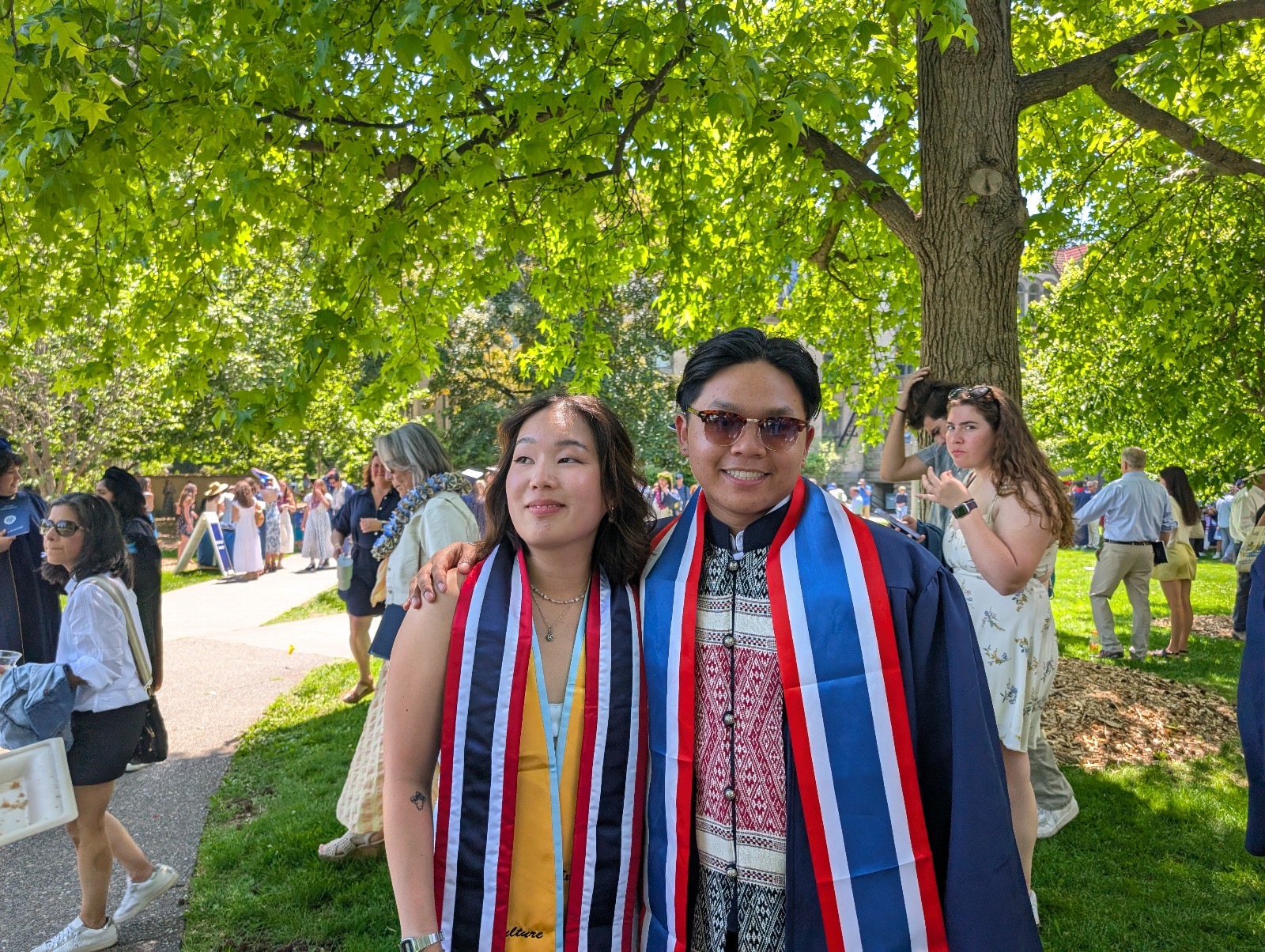
Meet Bright
Introduce yourself!
“Hi, my name is Napat Surit, but you can call me Bright. I’m from Chiang Klang, Nan, Thailand, which is pretty rural. I went to Pua School, about 30 minutes from my house. Since I was a kid, I’ve always wanted to explore the world, try different foods, and learn languages.”
What are you doing now?
“I’m finishing my undergraduate studies in Geology and will be working in North Carolina for a company called Sidelco. They focus on mining and glass recycling.”
Tell us more about your upcoming work in North Carolina.
“People might say mining isn’t clean, but from a geology perspective, it’s cleaner than petroleum or fracking. I’ll be working in the technology and innovation department, helping to find cleaner ways to extract and purify minerals.”
When asked what shaped his passion for the environment, Bright touches on the high levels of air pollution and agricultural burning in Northern Thailand.
“Farmers don’t have many options; burning crops is cheap and fast. But I always thought, ‘There has to be another way.’ Later on, my international studies in Germany were eye-opening because people recognized the issue and found real solutions. That really inspired me.”
Growing Up in Rural Northern Thailand
“I never thought it was rough. I’d wake up at 5:30 a.m., iron my uniform, grab some moo ping and sticky rice or congee, and catch the bus by 6:30. School ended around 4:00 p.m., and I had an extra class until 5:30.
Some kids had it tougher, helping with farming, for example, but for me, rural life had a special kind of peace. I can’t really explain it to people from Bangkok or the U.S. It’s slow, but you’re never bored. You’re always learning, always connected.”
Bright’s school also offered a club period, and he joined the Northern Cultural Preservation Club.
“We practiced traditional dances and learned about the Northern Thai script, which is different from standard Thai. In the North, we try to hold onto our dialects and traditions. It’s nice to learn about your roots.”
He also briefly participated in his school’s Youth Council, though he admits the only thing he remembers is separating trash. Haha
What about the slowness, or what some call the sabai culture, of rural life feels so ineffable?
“Growing up, I was always told to just go to school, enjoy it, and trust that my future would come if I followed the right path. That gave me a sense of comfort—but also uncertainty. What happens after graduation? A lot of people from the countryside want to move to the big city.”
“In rural schools, it’s easier to stand out academically. For me, things were pretty relaxed—I wasn’t worried. I stayed on track, didn’t drink or smoke, and focused on my path: studying, playing football, and eating good food with friends. Of course, it isn’t easy going for everyone. But in the countryside, there’s less competition. Honestly, if I had gone to school in Bangkok, I don’t think I’d be where I am today. Opportunities there often go to students with privilege or access to better education. In rural areas, we may have fewer resources, but more access to personal relationships. You can actually talk to your teachers about things like scholarships, which makes a difference when you’re one of 20 students applying instead of one of 500.”
Bright mentioned two notable scholarships that have changed opportunities for rural students:
- ODOS (One District, One Scholarship): Offers full scholarships to study abroad. One per district, so however many districts make up one province, that’s how many scholarships are available for students from that province.
- Rural Doctor Scholarship: Pays for medical school, with the agreement that recipients return to work as a doctor in their home district for five years.
How did you balance the rural “sabai” mindset with the drive to seek out opportunity?
“It’s like this—you don’t want to build a wall when you’re already being attacked. You build it before. There’s this mindset in the countryside that everything will just work out—but if that were true, everyone would go to college. And they don’t. I think I was preparing myself without realizing it, partly because of how we’re raised to respect our teachers and parents. They’re like our second family. If you want your kid to have a good future, you send them to the best school you can, with teachers they’ll listen to.”
Experience With the Peace Corps and English
Bright’s first encounter with the Peace Corps came at age 13.
“Our Peace Corps Volunteer was Justyn, from California. His teaching was really different—less about grammar, more about real communication. We played games like charades, watched movies, and learned idioms. (that’s when I learned ‘Bless you!’)”
He recalls how the fun and engaging lessons made English feel less like a subject and more like a bridge to the world.
“We always thought GPA and exams were the only way out. But Justyn made English fun. That stuck with me, as I want to understand people and get to know people from all around the world.”
What are your thoughts on a teaching style that prioritizes interaction and communication over test scores?
“As a middle or high school student, the games were great because they broke up the routine of more structured classes. They made English feel different—not just another subject to memorize, but something fun, something alive.”
“Keep playing games. Keep encouraging kids to speak and interact. It helps them see that English isn’t just about exams—it’s a real language used by millions of people. Once we understood that, we were like: ‘Wow!”
Taking English Seriously and Opportunities
What motivated you to take English seriously?
“When I was around 13 or 14, school was still pretty relaxed. But then a new principal arrived and started enforcing a strict haircut policy—military style. I refused to cut mine. A teacher stopped me one day and told me to get it cut. I argued back, saying there was nothing about that in our school agreement. We have a saying in Thai: ‘Turn white to black, black to white’—basically, to forcefully change things in a negative sense. This is what I felt the new policy was doing. Eventually, my dad was called in. The school told him that I either had to cut my hair or find a new school. I was so mad. From that day on, I made it my mission to prove myself. I wanted to succeed. That became my mindset.”
“Not long after, I had a chance encounter with a foreigner who was lost. I asked him, ‘Where you go?’ (my English was still rough.) But I tried. A teacher saw this and nominated me for a regional English competition. It was three months away, right after summer break. I panicked—I didn’t even know what the past tense was. But I didn’t want to show up looking stupid, so I spent the entire summer studying on YouTube and reading grammar books. That was the turning point. I realized English could open doors—not just to exams, but to people, to cultures, to opportunity.”
This mindset carried Bright into a bold next step: applying to UWC (United World Colleges), a highly competitive international study abroad program.
“Most programs I found were short—one year, then you return. But I wanted something more. UWC offered two years abroad, and I didn’t even know where I might be placed (he ended up in Germany!), but I applied anyway. I was ready to leave my school and see more of the world.”
“In the essay, most students (who were also mainly from rural areas around the globe) wrote about wanting to gain access to a ‘better’ place with more opportunities. But in my essay, I talked about my passion for where I’m from. One of the biggest things I learned from the Northern Thai Cultural Preservation Club was to feel confident and to be confident in yourself. You have to know first who you are and where you are from, and where your community is. “Thai” is made up kind of like “American” in the sense that people from different regions with different languages or dialects come together and create a country. In school, you’re typically only taught about “Thai” history as it pertains to Bangkok, which doesn’t answer my question of who I am. But learning about the local culture did, so I wrote my essay on that and how I wanted to share my culture with the world, and tell people to be confident in who they are. That message stood out to the committee.”
Identity Abroad: What It Means to Be Thai
Bright’s time abroad gave him new tools—language, education, and a global perspective—but it also sharpened his awareness of how Thai identity is viewed and valued, both inside and outside of Thailand.
“Being overseas makes you feel more Thai because you want to preserve that part of yourself; speak the language, cook the food, represent where I came from. But at the same time, I noticed something back home. A lot of Thai youth were trying to be anything but Thai. Speaking English, dressing like K-pop idols, listening to American rap—even if they didn’t understand it, it’s seen as cool or elite.”
“There’s this belief that if you can speak English fluently, you’re more educated, more modern. If you want the best phone, it’s from the U.S. The best clothes from Japan. If you want to look good, you copy Korean artists. And I get it—we’re surrounded by global influence. But it made me wonder: where’s the pride in our own culture?”
This tension, between pride in one’s roots and the desire for global belonging, continues to shape Bright’s outlook today. And it’s part of why he’s so passionate about young people in Thailand seeing English not as a status symbol, but as a bridge to opportunity.
Advice for Peace Corps Volunteers: Teach More Than a Language
Bright’s experiences growing up in rural Nan, learning English as a pathway to opportunity, and reflecting on identity while abroad, have left him with a clear message for current and future Peace Corps Volunteers:
“Please, please, please show the kids the hope. Show them that English isn’t just another class they’re forced to take. Help them see it as a tool, a way to connect, to explore, to dream bigger.”
“In rural schools, English often feels like just grammar and memorization. But it can be so much more. Make it fun. Make it real. Play games, tell stories, let them talk. Show them what they can do with it.”
English doesn’t belong to any one country—it’s a global language. And knowing it can give them access to people, ideas, and opportunities far beyond what they see in front of them. For Bright, it wasn’t perfect grammar or test scores; it was confidence, curiosity, community, and a teacher who showed him that English could be joyful and alive.




 Sticky Rice
Share your thoughts