
Tucker Strauch, 136 YinD
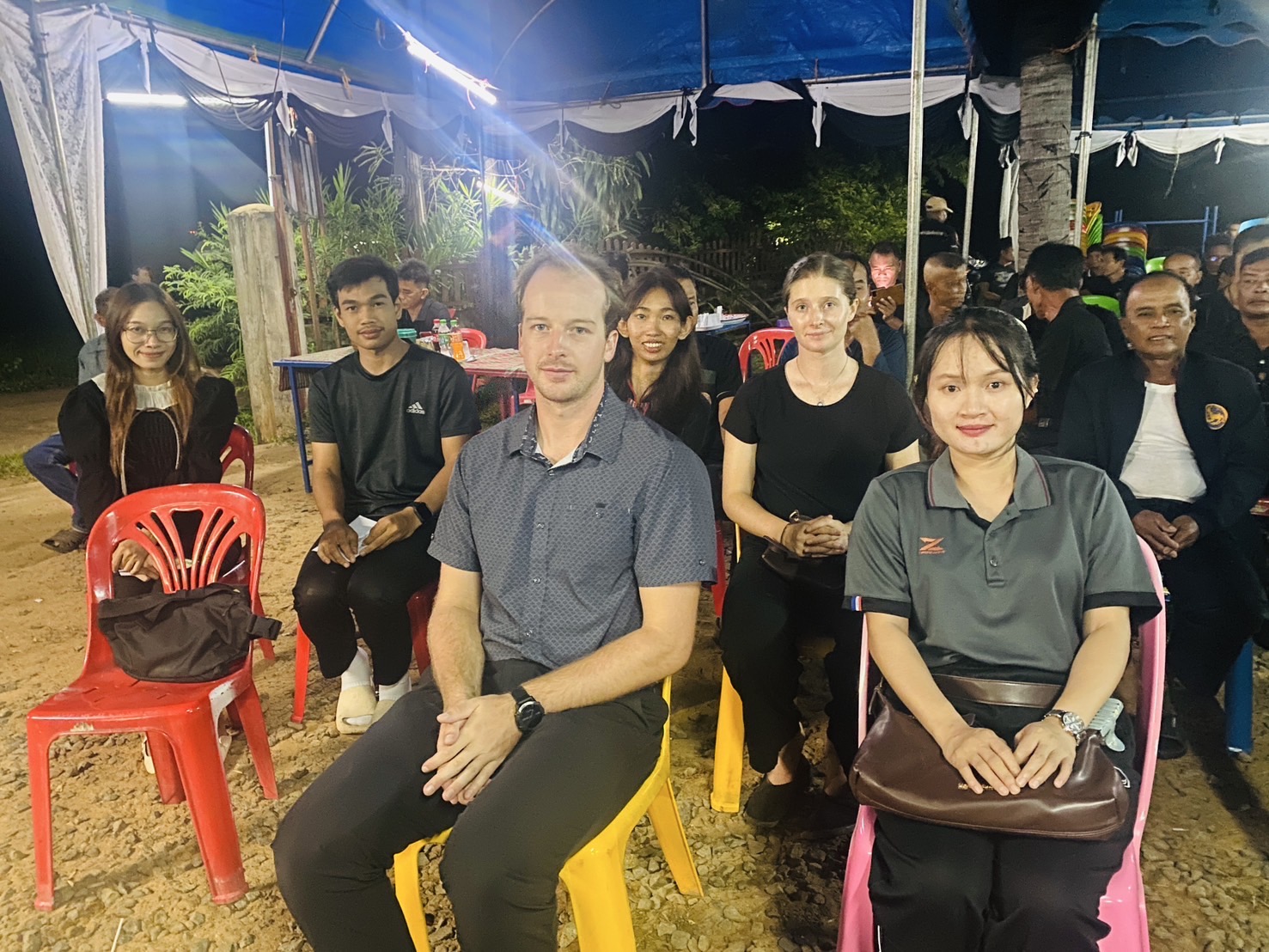
Very soon, upon first arriving at site, the principal of Ella’s school told us to put on our best black outfits because that night, we were headed to a funeral. It was a sweltering hot evening at the end of March, made even worse by the heavy, long-sleeve handmade shirt that the principal had given me to wear. The funeral was hosted at a house down the street from us, and about a hundred chairs had been set up to face a row of monks that were sitting on an elevated platform. The family of the deceased sat in a separate room with the coffin while the whole ceremony took place. The principal led Ella and me to the front center row and waited for the ceremony to start. Once the mayor got up to bow to the Buddha, everybody raised their hands in a relaxed prayer position, the monks started chanting, and the ceremony had begun. After about 20 minutes of chanting, everybody who had donated any amount of money (which seemed to be almost everybody in the crowd) was called up to kneel in front of the monks, wai them, and then make merit by offering the money to the monks. That first funeral was a little stressful, trying to copy the principal and the other teachers’ movements while not offending the monks or accidentally committing a sacrilegious act in front of my whole community. By about the third funeral, I had the process down, and it wasn’t nearly as nerve-racking. After the ceremony, everybody in the community sat at a long table and was served a whole array of Thai food that the hosting family and neighbors had prepared.
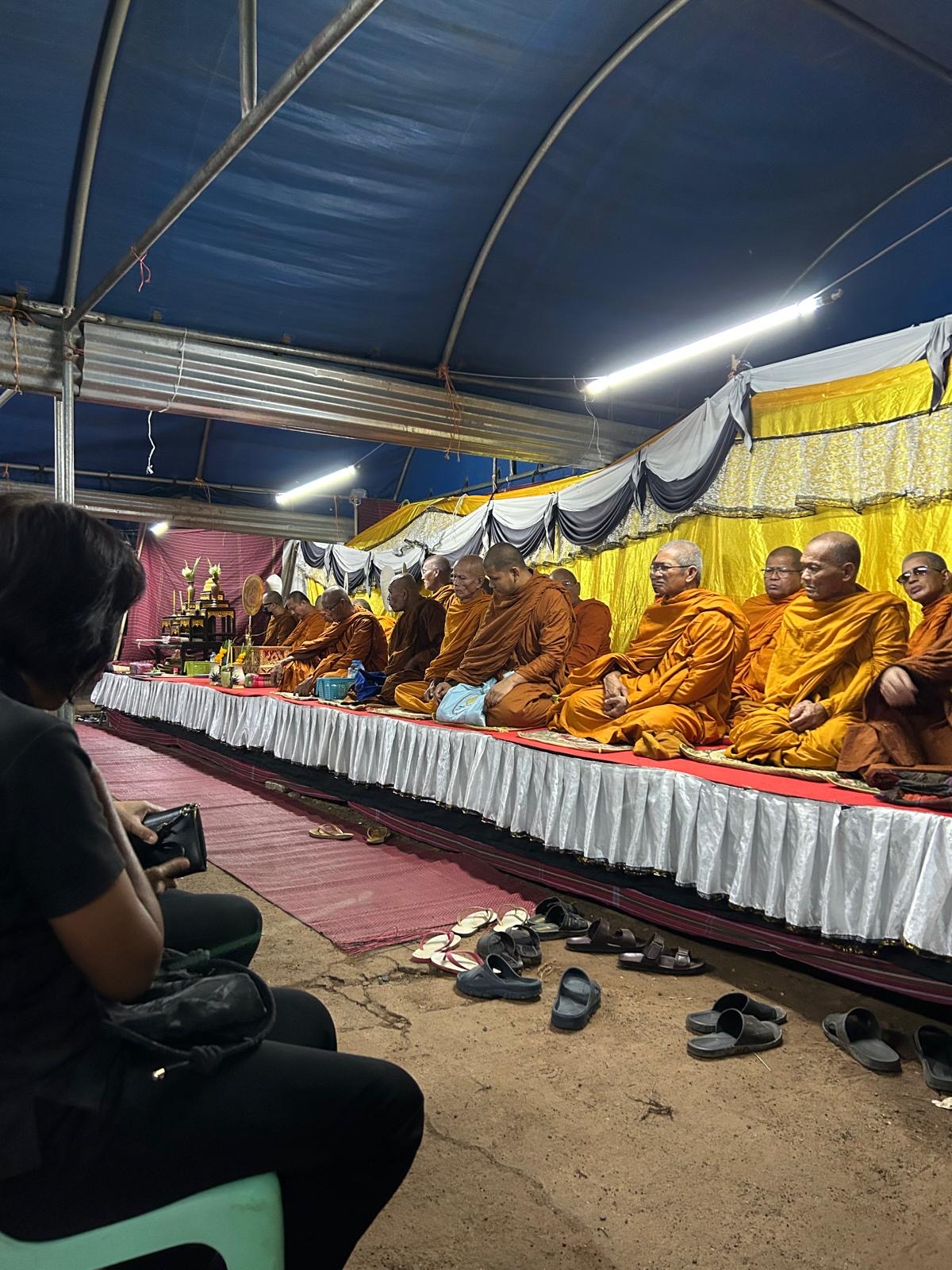
This first funeral was unlike any other funeral that I had attended. It lasted five days –Thai funerals are usually between 3-7 days, but always last an odd number of days and usually a higher number depending on the status of the deceased individual. People were dressed in the appropriate colors, but they didn’t necessarily dress formally. The family of the deceased stayed in a side room, outside the attention of the ceremony. Instead, most of the attention was paid to the high-status individuals sitting in the front (which included Ella and me, for this first one) and the row of monks. Rather than tears, there was a lively chatter amongst the crowd, maybe even a few pictures being taken for the Facebook page. The night of the last day of the funeral, the hosting family followed local customs and used a good sum of the donated money to hire a live singer, dancers, and hosted a party in the middle of our tiny village. Next Monday at my SAO, my counterparts asked me what I thought about my first Thai funeral. They got a pretty good laugh when I said that I didn’t think they were as sad as funerals in the U.S. I quickly tried to walk the comment back, but, based on my snap judgment, it was true.

On the last day of the funeral is the cremation ceremony. This final day felt more familiar to me, closer to the funerals that I’ve been to in the U.S. People congregate at the wat, dressed in more formal funeral attire, and have one last ceremony to pay respects to the dead and to say a final goodbye. There is tributary music, the family of the deceased plays a more central role in the ceremony by standing in the front, and there are most likely some tears. At the cremation ceremony that I went to, I, along with a large portion of the audience, walked up to the casket, placed a merit cloth on top of it, wai’d the Buddha, and walked back, all while some monks threw little ribbons filled with baht out for the kids.
Funerals in Isaan are community events, so everybody goes. In my relatively short amount of time here, I’ve already been to several. How sad the passing of one’s friend or family is, obviously, highly subjective and rarely a happy experience. However, throughout my time in Thailand, I have noticed that Thai people have a different relationship to death than people in the U.S., especially highlighted through a personal loss. A couple of months ago, my grandfather, who had been suffering from Alzheimer’s disease for about two years, passed away. Before leaving for Thailand, I went to say goodbye to him, but by that point, he was unrecognizable from the person that he once was. While I left for Thailand, having already made peace with the fact that my grandfather was gone, his ultimate death was still hard for me. I carried on with my teaching duties, and I told a few of the people at site closest to me because I hoped that they would trust me enough to share whatever was weighing them down at any given time. I told my host family not to get any type of reaction or to be treated any differently, but the reaction that I did get nevertheless caught me a bit off-guard. They simply asked, “Are you sad?” I couldn’t help but laugh. While the language barrier, along with cultural communication differences and my host family’s unique relationship with death, may play a role in this reaction, I think that this interaction highlights a Thai relationship with death in which sadness is more balanced with acceptance.

In Thailand, the higher degree of acceptance of death relative to the U.S. and other Western cultures may be related to Buddhism and the way death, as well as life, is viewed within Buddhist practices. The vast majority of Thais consider themselves to be Buddhist, and whether most people are staunch practitioners or not, the core elements of Buddhism permeate many aspects of Thai society. In Buddhism, impermanence (anicca) is a central truth. Neither happiness, nor grief, nor life itself lasts forever. Death, then, is not an interruption of life but simply part of its cycle. The Buddhist idea of impermanence often seems to shape a cultural acceptance of death that I haven’t experienced as much in the U.S. This perspective seems to translate to the way that Thai communities approach funerals –sadness is present, yes, but acceptance, ritual, and even joy play the leading roles.
Funerals in Thailand haven’t made death less sad, but they have illustrated how sadness is not a necessary emotion as it relates to death. In Isaan, grief is shared, meals are eaten, music is played, and life continues. Death isn’t a taboo subject or viewed as the ultimate end; rather, it’s acknowledged, accepted, and even folded back into the rhythm of community life through tradition and ritual. And it is in that balance between sorrow and acceptance that I’ve started to see a gentler and more embracing way of carrying my own losses.



 Sticky Rice