Welcome to the “What We’re Reading” ongoing series where Volunteers talk about the books they’ve been reading at site. Here you’ll find PCVs sharing their thoughts, reflections, and reviews on books of any genre. Leave us a comment below if you’ve also read any of these books!
Gretchen Evans, 136 YinD

My next-door site neighbor is up next! Emily Hoffmeister is a 135 YinD Volunteer serving in the Mukdahan province. A Winter Park, Colorado native, Emily went to Whitman College in Walla Walla, Washington, graduating with a major in Philosophy and a minor in Biology. Besides hanging out with the water buffalo deep in Isaan, Emily spends her free time tracking moon cycles, creating beautiful artwork, and catching up with friends. Emily and I have a fun little book exchange, and I am so glad to have her nearby to ask these bookish Q’s.
What has it been like reading at site?
Reading at site has been one of my greatest outlets. So cheesy, but reading truly is powerful. In times of isolation, I have my books to turn to. I’ve always enjoyed reading, but primarily only read for academic purposes. Peace Corps has gifted me some of my first moments of true boredom, where I felt I chose to read instead of feeling as if I needed to keep up with my ever-piling course load or social book clubs. Perhaps it is the lack of these things that leads me to choose to read, reminiscent of some sort of academic satisfaction which my brain has been trained to pursue. However, given the nature of it being my choice, I feel reading has taken on a new quality for me; what do I choose to read?
Reading at site has allowed me to experiment with new genres and shown me the range that books can cover. One of my favorites is a reading challenge I recently took on with fellow volunteer Lilly Hromadka, which we call “Reading the World”. We are trying to read a book from every country, written by an author who is from that country. Reading can truly transport me and expand my worldview. I choose to read about people and places different from what I’ve been exposed to before. I try to find opposing views on a similar topic and read them both. Reading allows for insights I could have never imagined I would have while sitting in the rice fields of Mukdahan. It makes my service feel richer, and I feel blessed to be filled with so many unique stories, perspectives, and sentiments of others.
What book are you reading right now, or have you recently finished? Thoughts? Do you recommend it? If so, who do you think would like it? Why or why not?
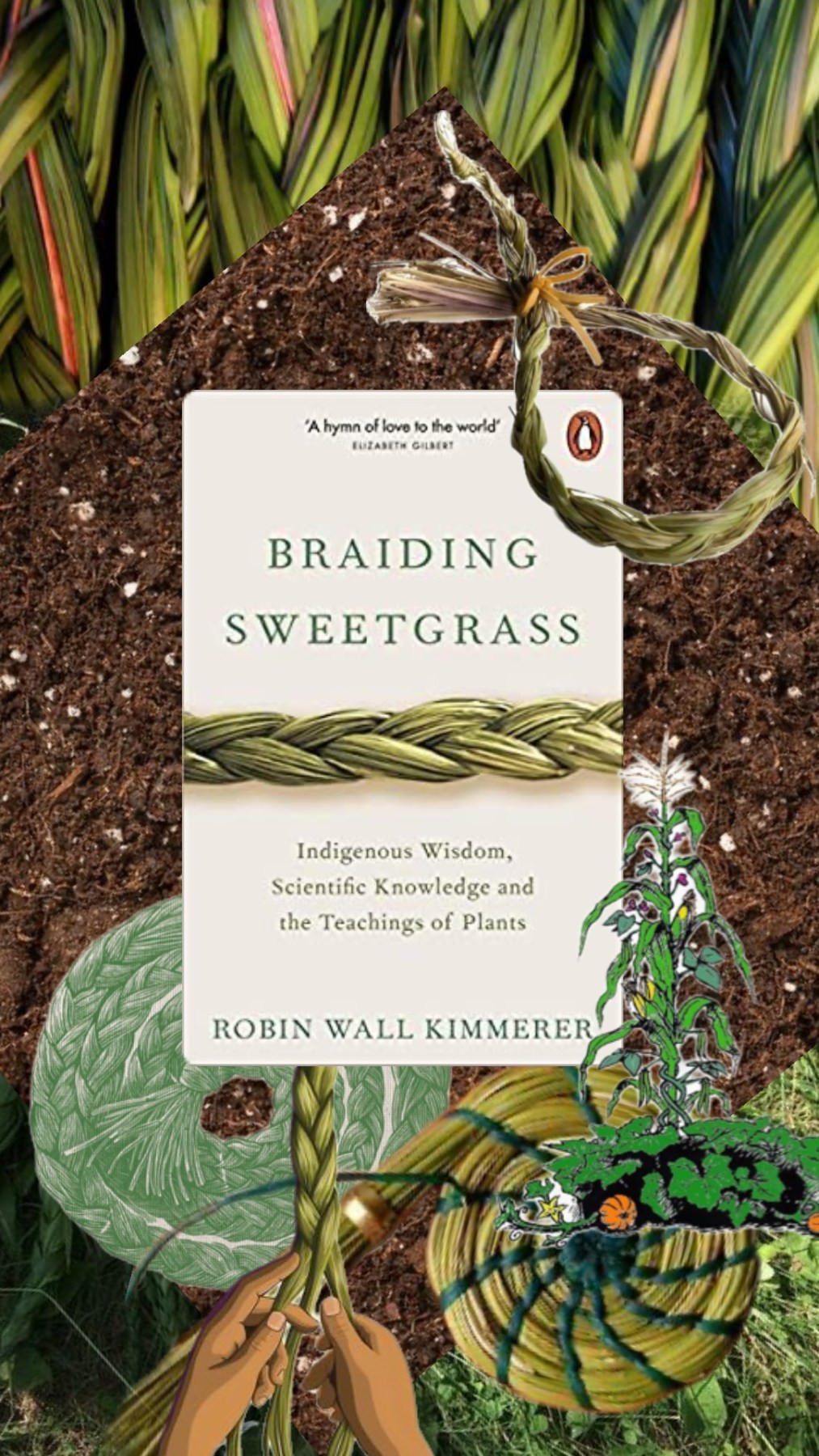
I am currently reading Braiding Sweetgrass by Robin Wall Kimmerer. I would absolutely recommend this book. Please everyone, it’s a MUST read! There are just so many quotes that really hit. Multiple times, I had to take a breath and pause during my reading. It’s one of those books that takes over your worldview during and after your reading. Gratitude, reciprocity, and the language of the world are now more illuminated to me because of it. If you’re passionate about ecology, botany, Indigenous knowledge systems, or nature writing, you’ll love this book. But it also speaks powerfully to those drawn to science, philosophy, and storytelling that reconnects us—as humans—to the earth and each other.
If you could be anyyy book character, who would you be? Why?
Hmmmmm… would Percy Jackson be a crazy answer?? I was always so jealous of his ability to connect to and be one with water. I also related to him a lot because he struggled with dyslexia. The idea that maybe my dyslexia was a sign that I am really a demigod made me not hate it as much. Going on quests, outwitting gods, and being a child of Poseidon sounds pretty sweet.
Do you prefer reading on a Kindle/eBook, listening to audiobooks, or physical books? Why?
It’s always going to be a physical book for me. I do own a Kindle and read on it a lot, given that there are no libraries, let alone English libraries are near me; however, physical books are always a treat. I’ve only ever listened to audiobooks in the car on road trips. If I’m doing an activity where I want to listen to something, music always steals my attention. Physical books draw me in. Kindles can do this as well, but nothing beats the feeling of the real book in your hand. The soft pages and the ability to see where your bookmark falls among them.
What non-fiction work do you believe people should take the time to sit down and read?
This is a hard one for me to answer. Sometimes I’m not sure if I like a book so much because of its content, the way it was written, or voice… or if I like it because of the lectures and conversations I’ve had with other people while reading it. Most of the non-fiction texts I always endorse come from the syllabus and Socratic seminars of past classes. So if I had to put together my very own syllabus, it would include works like: Between Past and Future by Hannah Arendt, The Zhuangzi by Zhuang Zhou, Being and Time by Martin Heidegger, and Sister Outsider by Audre Lorde. I’ll be honest, these aren’t the easiest books to casually read, but I think the thoughts and ideas behind the sometimes dense and abstruse language are worth working for.
- Hannah Arendt is a German-born Jewish American Political Theorist. Her book, Between Past and Future, describes the crises modern society faces as a result of the loss of meaning. This book is a call to action, encouraging readers to grapple with the challenges of the present by critically examining the past and actively shaping the future.
- The Zhuangzi is an ancient Chinese text and a foundational text of Taoism. I love this piece of work because of its comfort in chaos. One of the key messages is to embrace natural spontaneity to be better aligned with one’s inner self within the cosmic “Way”.
- If you like existentialism, Heidegger is for you! His main tenets deal with concepts of being, being in the world, encounters with entities in the world, being with, temporality, spatiality, and the structure of care. This philosophy radically changed the way I understand the meaning of Being for human existence.
- Sister Outsider is a collection of essays and speeches written by Audre Lorde. Lorde is known for writing about her blackness and queerness, and how both these identities overlap and intersect, shaping her personal feminism and how she views feminism in general. This text offers multiple layers (sexism, racism, homophobia, classism) showcasing how feminism does not exist independent of other ‘-isms’.
While I recommend these books, what I really recommend is having a conversation about them! It’s so much easier to process dense thoughts with someone else, and more fulfilling when you are forced to apply the ideas through active engagement. Continue the “reading” off the page.
Emily is one of the coolest people I have ever met! I firmly believe her self-proclaimed unquenchable thirst for exploration and desire to learn are admirable qualities. Our routine, thought-provoking conversations are certainly a highlight of my service. We are both curious people, and I expressed this side of my personality by posing a very important question: What is Emily’s bookish hot take?
Her answer was as follows:
Beat up and mark your books! Another reason I prefer physical books is that I love annotating, highlighting, folding pages, leaving sticky notes, etc. This is a huge part of the reading experience for me. My books often look a bit battered and worse for wear. The book I currently read accompanies me wherever I go, regardless of whether it’s on a trail while hiking, curled up in a hammock, or on a grubby classroom floor. Take books with you, extract and add as much as you can from them. This makes future references easy to find and transforms the book into a fun item to loan to a friend, as these ramblings and markings can serve as a point of future discussion.
While I can definitely understand the appeal of a well-worn book and an ample amount of annotations, I now know that a book lent to Emily is parting ways with order and saying hello to chaos! For more information on chaos theory and other topics surrounding continental philosophy, give Emily’s nonfiction book recommendations a try.




 Sticky Rice