
During training, Peace Corps shares a quote with us to help conceptualize the work we will be doing over the next two years. Although I’ve forgotten how exactly they put it, it’s a play on the proverb “The true meaning of life is to plant trees under whose shade you do not expect to sit.” Ask the internet and it’s credited to the Greeks, and several different modern men. Change “life” to “Peace Corps service” and we can credit it to our Peace Corps staff.
Regardless of where it comes from, it’s a phrase every trainee and volunteer uses to talk about their service, right alongside “the hardest job you’ll ever love.” It’s a reflection of the sustainable, long-term influence of the work we do here. We don’t always get to witness the outcome of the projects, connections, and collaborations started during service. Instead, we leave, and maybe in the years to come hear of the changes we planted. Students grow and blossom, programs are continued and adapted by counterparts, community members are inspired and empowered to be change makers. In the thick of it, these tasks can be an immense challenge to volunteers. Challenges which can be overwhelming and isolating, but equally facilitating personal growth and learning, as we struggle to find our footholds and understand the point of it all – the point of our Peace Corps service.
I find it immensely beautiful then, that many volunteers have found important trees whose shade they sit in at their sites. Trees, planted by someone unknown, nurtured and raised by a community that now embraces, inspires, and loves them. Trees with supportive roots that shelter our growth, nurturing branches to witness our success as we plant trees ourselves. Either in their front yards, or in the center of the community, they are landmarks of service around which people gather.
Today, our writers invite you to gather with them around their favorite trees.
B. Harris, 136 YinD
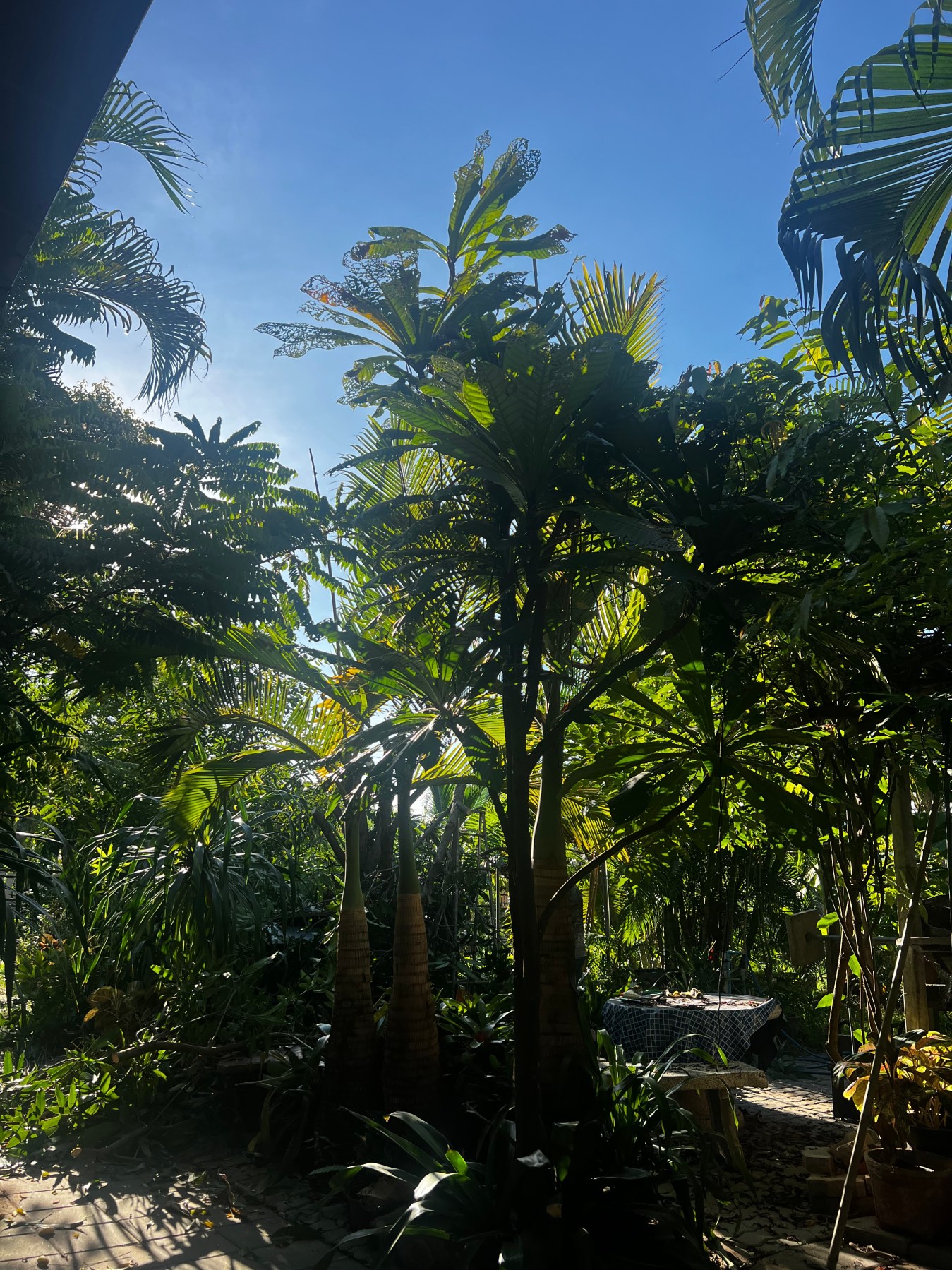
I had never given the trees around me any thought, so I couldn’t help but laugh when we were given this topic. I was certain that since I didn’t have a favorite tree, I wouldn’t be taking part in the group article this month. However, I became more aware of my surroundings as I sat outside my house with my host mother, watching my host dad chop down trees on the property. There are trees throughout, and I adore them. When I go to work in the morning and come home in the evening, they’re the first things I see. They offer shade and a haven for the countless butterflies that float about my house. I do, therefore, have a few favorite trees.
Kiera Hurley, 135 YinD
One of the first things that struck me about Thailand was the abundance of lush greenery and towering trees—ancient giants that feel as though they’ve stood watch over the land for centuries. At my site, the landscape stretches into a patchwork of rice fields, and farmers often string up hammocks beneath the trees, taking shade and rest beneath their leafy canopies.
But there’s one tree that rises above the rest—not just in stature, but in spirit. It has become a quiet landmark in my life here. Adorned with colorful ribbons and a small Buddhist offering nestled at its base, this tree holds a sacred place in the heart of the community—and in mine. Its broad trunk stands proud, its branches fanned out like open arms, sheltering a symphony of life. I’ve seen families of birds fluttering through its limbs, and even a pair of barn owls has made their home there.
At sunset, I often find myself drawn to this tree, walking slow circles around it or swaying gently in a nearby hammock. There’s a quiet energy in its presence—a deep-rooted calm that seems to wrap around me like a protective cloak. I always bring visitors to see it, hoping they’ll feel a fraction of the wonder and peace it brings me. This tree is more than just part of the scenery; it feels like a wise, living witness to the passage of time, offering shelter, beauty, and a place to breathe.

Jess Smith, 136 YinD
Life is full of jokes in all the best ways. The universe has a way of putting us in these ironic instances where you can’t help but laugh. For me, this instance became very apparent, very quickly, after the move to Thailand.
I am allergic to one thing: the oh-so-delicious mango, better known in Thai as the ma muang. Go ahead and guess what the most popular fruit is in Thailand.
Ma muang is a leading ingredient in Thai cuisine; mango sticky rice, papaya salad, savory dishes, and desserts alike. You can eat it raw, cooked, ripe, or unripe. Every meal, without fail, mango will be brought out, proceeded by the words: “Jess, gin mai dai” or “Jess, you can not eat this”. At first, I felt sad hearing this, but now it is a constant reminder that the people in my community care deeply about me. They announce this not to embarrass me, but to bring attention to my allergy and make sure I do not eat the mango that I so desperately wish I could.
So, as life loves to be ironic, there is a mango tree in my front yard. But I choose to love this tree despite my allergy. It has done nothing to me. It just exists. And it’s my favorite tree in this new place I call home. It serves as a constant reminder that perhaps the popular option is not always best. That which may serve others may not serve me. It reminds me to appreciate nature’s generosity without the need for consumption. Things can still be beautiful even if I have no part in them. I can admire from afar, and I can be happy for those who choose to indulge in the abundance. I can find the silver lining.

Though I can’t eat the sweet fruit from this large tree, it does provide me a place to sit and escape the sweltering summer sun. Perhaps, that’s the lesson to be learned. Perhaps life is full of irony to teach us something. Irony doesn’t have to be a bad thing. Or maybe the mango tree in my front yard isn’t ironic at all; maybe this is how things were always intended to be. This tree has taught me to change my perspective, and for that, I thank the universe for being a little ironic.
I think it’s important to find the humor in things. Without humor, life is dull. So I choose to find comfort in the fact that the only tree on my property bears a forbidden fruit. It’s okay if the tree is not meant to provide me with a mango to eat, it has provided me with a chance to see things from a different lens.
My mango tree represents community, self-control, and the ability to find the humor in life’s little ironies.
Mack Devoto, 135 YinD

Trees are often used as a symbol of life, community, growth, and persistence. I cannot think of a better way to represent my community and time here than this large, behemoth of a tree in the middle of the local temple in my neighborhood.
In rural Isaan, there isn’t much to look at. It is, essentially, all agricultural land, flat. I often refer to Isaan as the ‘Midwest of Thailand’, making it increasingly ironic that I ended up in a placement here, seeing as I am a midwestern girl, at heart. Perhaps these are just the vibes I give off and– if so –I am happy to be perceived in this way! Maybe this is why Isaan feels so familiar to me and has always felt like home, in a sense?
This tree is among the familiar aspects of my village. Its long arms open to embrace you, inviting you to rest leisurely beneath it on the surrounding stone, beckoning you to partake in her shade amidst the hottest of Isaan days. The tree resembles one I grew up with in my childhood home. A beautiful weeping willow graced my little backyard in suburban Iowa. I was always admiring that tree, the largest in the neighborhood by a long shot; I felt a kind of prestige knowing she was in my backyard. The envy of all the neighborhood kids who wanted to come over and climb her.
Upon my arrival in Isaan, this tree was one of the first things I noticed. I live across from the local temple, and the tree is, similarly, the largest and easiest to spot in the neighborhood. Her makeup, surprisingly familiar to that of the tree I from my childhood, her presence was the same in the community. The sheer mass of her reminds me that she has been around longer than any living person from the village, and she will remain here for even longer, the same as my Iowa weeping willow.
Trees remind me of how short my time is here, despite how long some days (and months) feel. She will outlive the memory of me, as the weeping willow does in the home my family no longer occupies. It’s a bittersweet reminder of how precious our time is on earth, and in our communities, and to make the most of it. I can only hope that some remnants of my time here will live on and continue to positively influence my community when I leave, in a similar manner to that of the tree’s saplings.
Emily Hoffmeister, 135 YinD

Sitting outside the office of my Sub District Administration Organization, this tree feels at the center of my community. I look out at it when working in the SAO, and I bike past it when going to and from my schools. This tree caught my eye from the very first time I saw it, largely due to its massive stature, but also because of the location. My point of orientation, and a reminder of nature appreciation.
Oliver de la Torre, 136 TESS

If I had to pick a favorite tree, it would be an easy choice—the mango tree right outside my house. It’s tall, leafy, and kind of steals the spotlight in the yard. But the best part? It’s basically a snack factory.
When mango season hits, things get busy around here. My host family goes into full mango-harvest mode. Everyone’s out there pointing at branches, debating which ones are ready, and climbing up to grab the “perfect” mangoes. There’s always at least one that falls and hits someone, but that’s just part of the experience.
Once we’ve collected a bunch, the real magic happens. The mangoes get sliced, dried, and turned into the tastiest mango candy—chewy, sweet, and just a little tangy. It never lasts long because, well, I keep sneaking pieces (guilty).
And then there’s my host grandmother, who’s a mango genius. She makes the most amazing mango jelly—smooth, golden, and full of flavor. She somehow gets the recipe just right every single time. The kitchen smells incredible while she’s making it, and I always try to hang around to “help,” which mostly means trying to score a spoonful before it sets.
The best part? We don’t keep it all to ourselves. Both the candy and jelly get packed up and shared with neighbors, friends, and visitors. It’s kind of become our thing—if you stop by, you leave with a sweet treat and a story about the tree.
Honestly, this tree does much more than just give fruit. It brings people together, keeps us busy, and adds a little sweetness to everyday life. It’s like having a giant, leafy gift that keeps on giving. Easily favorite.
Alyssa Strong, 135 TESS
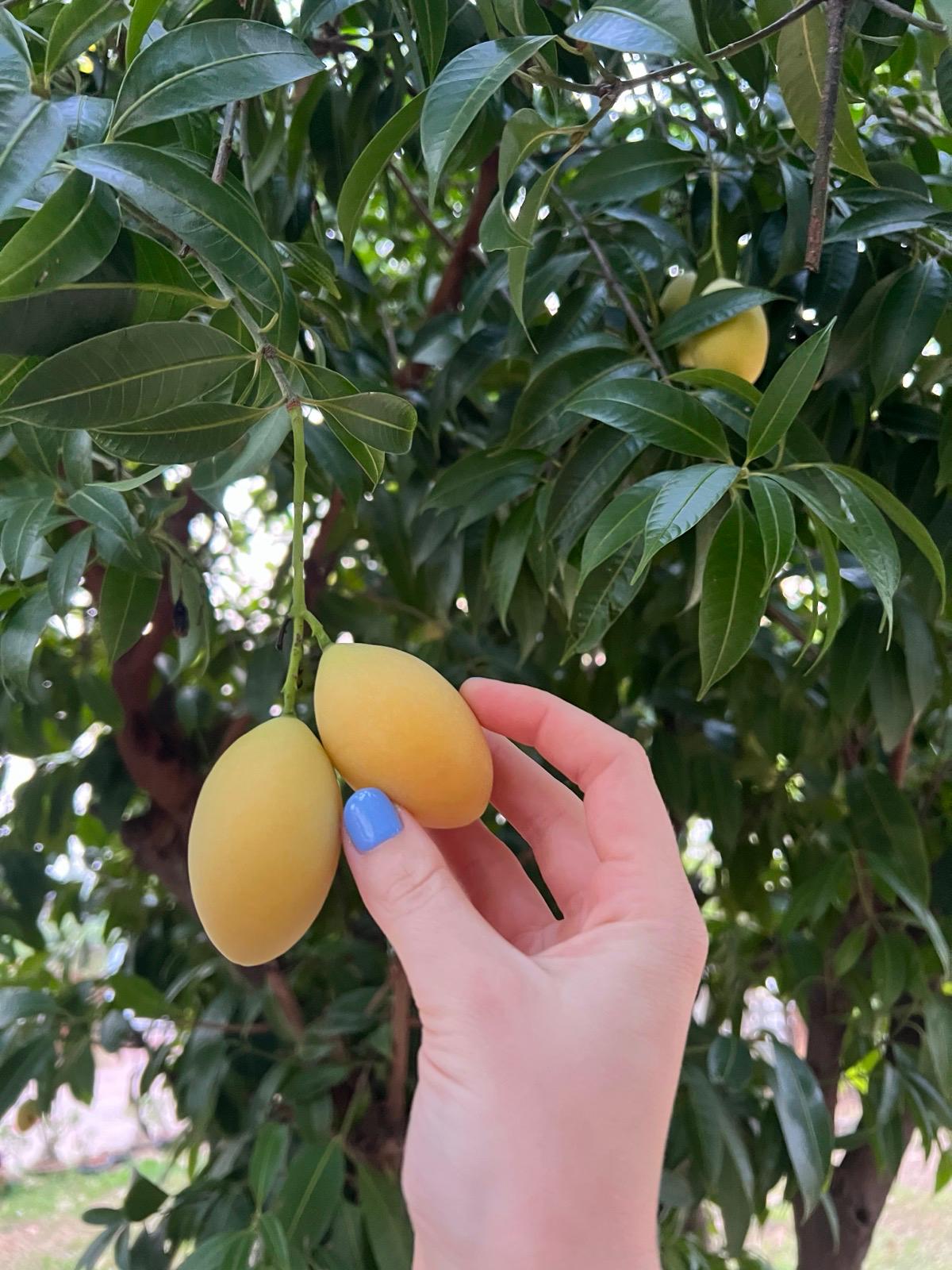
My favorite tree at site is my mayongchid tree because it gave me so many sweet moments to share with my community.
Around mid-March, I started to see small mango-like fruits growing on the branches of a tree in my front yard. I had never seen any fruit like it before, so when my landlady texted me that I could eat them when they turned yellow, I anxiously awaited their ripening.
They finally turned a bright yellow when my landlady hosted a monk ordination in my backyard. That weekend, I brought friends, old and new, who attended the ordination to the little tree in the front yard to escape the chaos and pick some of the first fruits. That moment, standing around the tree sharing mayongchids with my community was one of those “I made it” moments. I finally integrated. I felt part of the community, connected to the people in it on a deeper level. I was able to give something back to the people who have given so much to me.
The tree also provided sweet moments to share with my coworkers at school, an airport treat for my mom and sister, and a brewery snack in Bangkok for my friends visiting from Peace Corps Rwanda. I got to share a taste of my Thai home with not only the people who make Thailand feel like home, but also the people who live 9,000 miles from me. For that, I will always be grateful for my mayongchid tree.
Gretchen Evans, 136 YinD
One thing about Thailand is that it is hot (duh), and I feel instantly cooler under the shade of a pretty tree. Some trees are bred to provide this very purpose. The Samanea saman, or Rain Tree, is known for its expert shade-providing abilities. I have a Rain Tree, ต้นฉำฉา (Issan: Ton Chamcha)/ต้นจามจุรี (Thai: Ton Chamchuree), right in the heart of my town. The Rain Tree is also known as the Monkeypod Tree because of its large, curved seed pods, which are a favorite of monkeys.
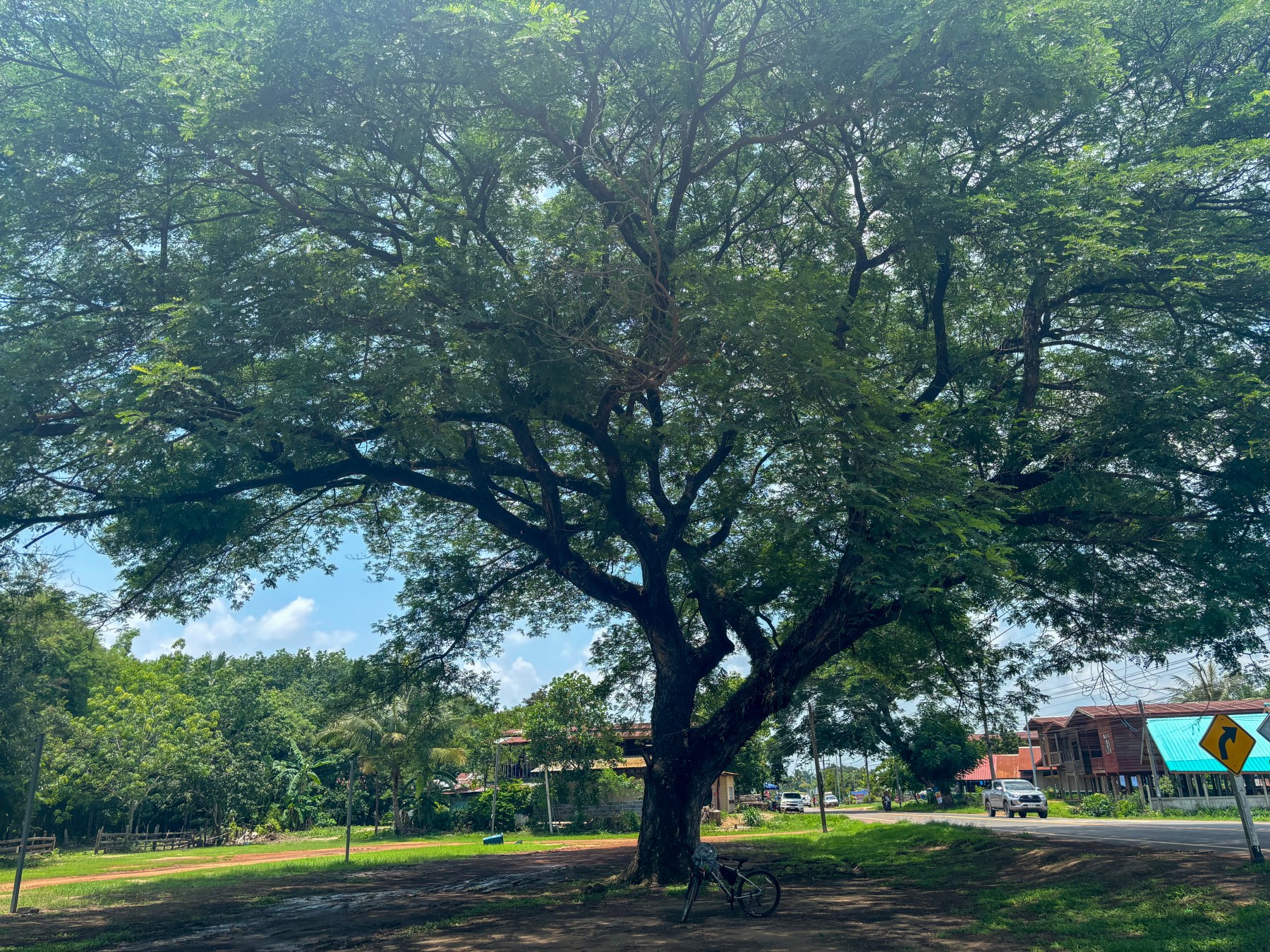
The Monkeypod Tree is native to South America, but it is popular globally, especially in Hawaii! First introduced in the late 1800s, this tree is favored throughout Thailand. In Kanchanaburi, there is a Giant Rain Tree over 100 years old! At my site, there is an abundance, each with unique branching patterns.

The tree at the epicenter of my town is the definition of lively. The particular Rain Tree in question is special because of its location and dynamic uses. It’s right next to one of my schools, so I often see students climbing or leaning against it and reading (!!). On Wednesdays and Saturdays, though, it truly transforms. My site has a rotating market, and its location changes daily. This tree acts as a refuge from the sweltering heat and a support system for tents and signs on the days the market is stationed here (Wednesdays and Saturdays). Hundreds of people buy clothes, food, hair accessories, and all the necessities. On days when I attend the market, I look up at this Rain Tree and appreciate its beauty and utility. Thai culture is centered on community and gathering, and the umbrella-like canopy the Rain Tree provides is an invitation to this way of life.
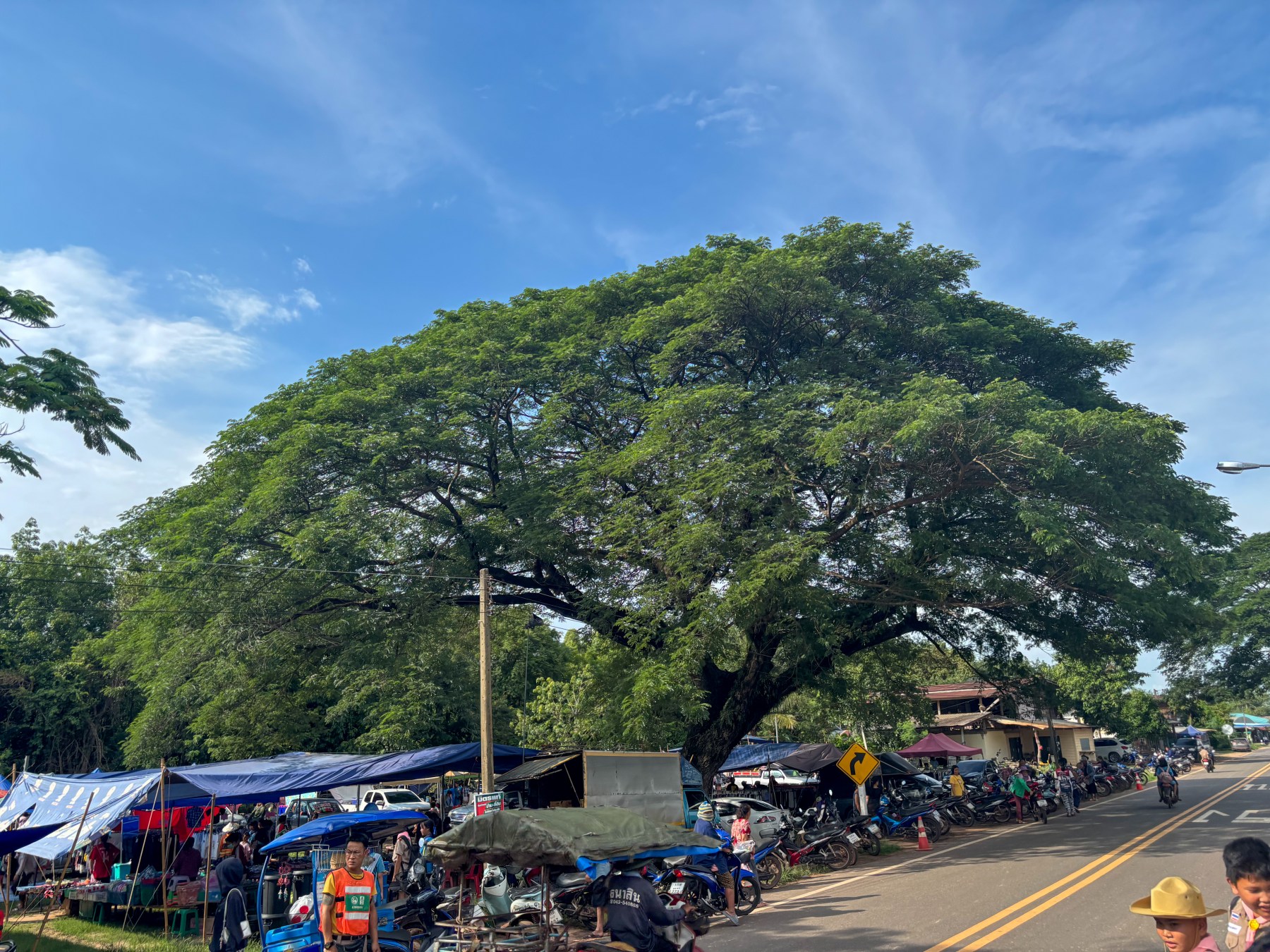
If you feel inclined, plant or gift a Monkeypod Tree! Per their website, organizations like Grow Billion Trees Partners are making significant strides in promoting the planting and care of Monkey Pod Trees, ensuring that future generations can enjoy their many advantages.



 Sticky Rice