
Michael Swerdlow, 135 YinD
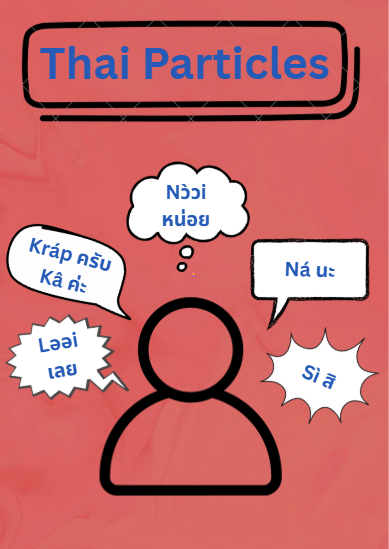
As a non-tonal language, English uses intonation and stress to convey emotion in a sentence. The simple phrase ‘come here’ can have a plethora of meanings depending on the intonation and stress in your voice. Thai, on the other hand, is a tonal language, and thus, employs a different technique to express the mood of the sentence: Particles. Particles are words in the Thai language that are placed at the end of sentences to convey the proper emotion behind one’s message. If you want to be polite, sweet, stern, friendly, and everything in between, Thai has a particle for every context. Using particles will help you sound like a native speaker as they add personality, character, and emotion to your sentences.
Here are the top 10 Thai particles I use or hear daily:
Kráp ครับ /Kâ ค่ะ 🙏 – Kráp/Kâ are the most important Thai particles, and they let that be known. They are THE premier Thai particle, loved by everyone and used by all. Kráp/ Kâ are the polite particles. They are used in all contexts/conversations to demonstrate respect and politeness. Greeting someone, use Kráp /Kâ; asking or answering questions, use Kráp /Kâ; giving or receiving instructions, use Kráp /Kâ. Always keep them in your back pocket, because it won’t be long before you will need to use them again.
Kráp Pŏm ครับผม🫡 – Kráp pŏm is the big brother, 10 years older than Kráp / Kâ. The brother who always responds yes, sir/ yes, ma’am because of his maturity and endearing nature. He is the exemplary role model we all look up to. With age comes wisdom, and when you look into Krap Pŏm’s eyes, you can see the years’ worth of experience. He always seems to know what to say, and just how to say it. He is polite like Kráp / Kâ but is more endearing by delivering his message with poise and grace. When you want to be polite, yet endearing, you can use kráp pŏm.
Jâa จ้า 🤗 – Jâa is the sweet auntie who always pinches your cheek and tells you how wonderful you are. She is still polite but not as formal as Kráp/Kâ. She is used in more intimate relationships to show you care for and love that person.
Ná นะ 😁 – Ná is an invaluable part of the team. The Swiss Army Knife of the Thai particles. The athlete who is willing and able to play any position. Ná plays almost every snap. When she is taken out of the game, it’s not long before she’s already asking, ‘Put me in, coach.’ Here are some positions Ná can play: Ná can soften your message to express non-urgency and gentleness: ‘Pass out these papers for me, ná’ or ‘Watch this video, ná.’ It can also express your adoration: ‘You’re really sweet ná’ or ‘You’re really smart ná. Ná can add emphasis and love: ‘Congratulations ná,’ ‘Happy Songkran ná,’ or ‘thank you so much ná.’ If ná were to ever get injured, I don’t know how good of a season the Thai particle team could have.
Sì สิ 🪖 – Sì is the drill sergeant of the Thai particles. The stern particle who gets results when he wants something done. ‘Come here sì!’ ‘Sit down sì!’ ‘Stop sì.’ Sì adds emphasis to your message. But be careful, he may come across as rude or aggressive in the wrong context.
Wá วะ 😏 – Wá loves to be sassy just for the heck of it. Wá can also show your irritability and impatience in certain situations. Wá loves to show her contempt, disgust, dislike, annoyance, and even anger to just about anyone who wants to hear it. A common particle used with close friends. But warning! It is rude to use wá with strangers, parents, or anyone else higher on the social hierarchy than you.
Ləəi เลย 🤩 – Ləəi are the cheerleaders of the team. Ləəi keeps the energy and morale of the team high by always encouraging others. For anyone showing fear, uncertainty, or doubt, ləəi is always by their side. For example, for any students showing fear or hesitancy about their ability to speak English, ləəi is right there saying ‘tam dai ləəi(you can do it!). Ləəi also intensifies your message as in ‘Let’s go! (bpai ləəi) or ‘Let’s eat!’ (gin ləəi)
Nɔ̀ɔi หน่อย 🤔 – Nɔ̀ɔi is the most inquisitive particle by nature. Always willing to ask questions or for permission. If you want to ask to do something or you need something, nɔ̀ɔi is your go-to person. Nɔ̀ɔi asks questions in a gentle and non-pushy manner. For instance, ‘May I have the scissors nɔ̀ɔi?’ or ‘May I use the restroom nɔ̀ɔi?’
Rə̌ə เหรอ 😲- Rə̌ə likes to be pronounced with an ‘L’ instead of an ‘R.’ If you want to clarify something playfully, rə̌ə can lend a helping hand. For example, ‘Oh, really?!’ (jing rə̌ə) or ‘You already ate lunch rə̌ə?!’
Nə́ เนอะ 🧐- Nə́ loves to get along with everyone and is always seeking validation. He wants to be liked by everyone and is always asking others if they agree with him or not. For example, ‘This looks like a fun game nə́’ or ‘This dog is cute nə́.’
Each Thai particle comes with its own identity, helping the message meet the matching emotion. They also love to be mixed and matched together to combine emotions. For instance, a cashier inviting the next customer in line to the counter may use three particles at once by saying, ‘chəən ləəi ná kâ’ (เชิญเลยนะค่ะ). All particles work together to convey the nuance of emotions behind your message. By not using particles, one may come across as impolite or dry. These 10 are only a small sample of the plenitude of Thai particles. All particles are valuable tools to put into your toolbox.




 Sticky Rice