
This month is the start of school, two months at site for Group 136, a year and 2 months for Group 135 (10 months to go!), and the beginning of a 3rd year for our 134 extendees. There is so much to say, in appreciation, love, gratitude, grief, and acceptance when it comes to the life of a Peace Corps volunteer. There is so much to look back on, and forward to. Each of our services is unique, each writer choosing different moments to focus on, but the underlying connection is obvious. While our individual writers haven’t quite reached such a hefty word count, they showcase moments, memories, laughter, and joy, captured forever and beyond writing, in a picture worth a thousand words.
Jess Smith, 136 YinD

What song is it you want to hear?
This is an iconic question that has echoed through generations of classic rock lovers. To me, the answer has always been Free Bird by Lynyrd Skynyrd. This song and the image I captured of a bird soaring across an empty sky hold deep personal meaning. They remind me of where I come from, the people who have shaped me, and where I feel called to go.
In a time when iPad kids hadn’t taken over the world yet, kids found other ways to spend their time, and for me, this was listening to music. A large part of my childhood was filled with music, bands, and facts from decades before I was born. I grew up in a home where music wasn’t just background noise, with parents who loved classic rock, which led me to share that same love of music. We played Shazam before Shazam had a name, yelling “Who sings this?” within seconds of the guitar intro.
This shared musical culture has shaped more than just my taste, though. It’s why I know random facts about not-so-random rock stars, and why songs like Free Bird mean so much to me. I could tell you that Stevie Ray Vaughan died in a helicopter crash that Eric Clapton was supposed to be on instead. Or that it was unironic that “Video Killed the Radio Star” by the Buggles was the first music video played on MTV. Or that Lynyrd Skynyrd named their band after their high school teacher.
Music has also given me stories, inside jokes, and has shaped how I see the world and my place in it. Like how I never grew up listening to The Beach Boys because my dad once drove them during a short stint as limo driver and their failure to tip means their music sucks. Or how every time Bennie and the Jets plays, I sing “Benny and the Jess” because my brother and I are Ben and Jess, and our parents always sang it that way.
So when I took this photo of a bird flying alone in the sky, it instantly reminded me of Free Bird. It reminded me of how the song has followed me throughout my life. Especially now serving in the Peace Corps. As I left home, I couldn’t shake the feeling that I might miss out on life’s little moments with the people I love back home. I hear the lyric “Would you still remember me?” and feel its weight now that I live far from everything familiar. But I carry with me this constant yearning to see the world and make a difference, and in many ways, I’ve always felt like the bird “you cannot change.” I think that is the beauty of the song. It captures the longing to move on, the sadness of what we leave behind, and the reassuring feeling of knowing it’s what we’re meant to do. And I know I was meant to serve in the Peace Corps.
Now, when I see a bird flying amongst the rice paddies or perched in the mango tree outside my house, I think of that song. I think of growing up with music and my parents, who gave me the wings to chase my dreams. And I’m happy to be where I am and know I’ve become the bird they cannot change.
Tal Carmel, 136 YinD

As I sat eating my food,
Another few new meals whose names I didn’t remember,
I watched the women in front of me.
They were gathered around dying each other’s hair.
As I watched one woman wipe the hairline of two others, I had a thought:
Women are women everywhere.
In that moment, it reinforced my resolve,
I was in the right place.
I was IN the right place.
It wouldn’t matter where I was stationed or what was around me.
Women are women everywhere, and I came here for community.
I came here for people.
I came here for love.
And I would find those things everywhere.
I did not come here for luxury.
I did not come here to “copy/paste” my previous life.
I came here to start fresh, to start over, and to start right.
There is no other option for me.
Women are women everywhere.
Strong. Resilient. Adaptable.
And I? I am a woman.
—
This was a piece I wrote while site placements were still a mystery and at the forefront of my mind.
Kayla Kawalec, Peace Corps Volunteer Leader, 134 YinD
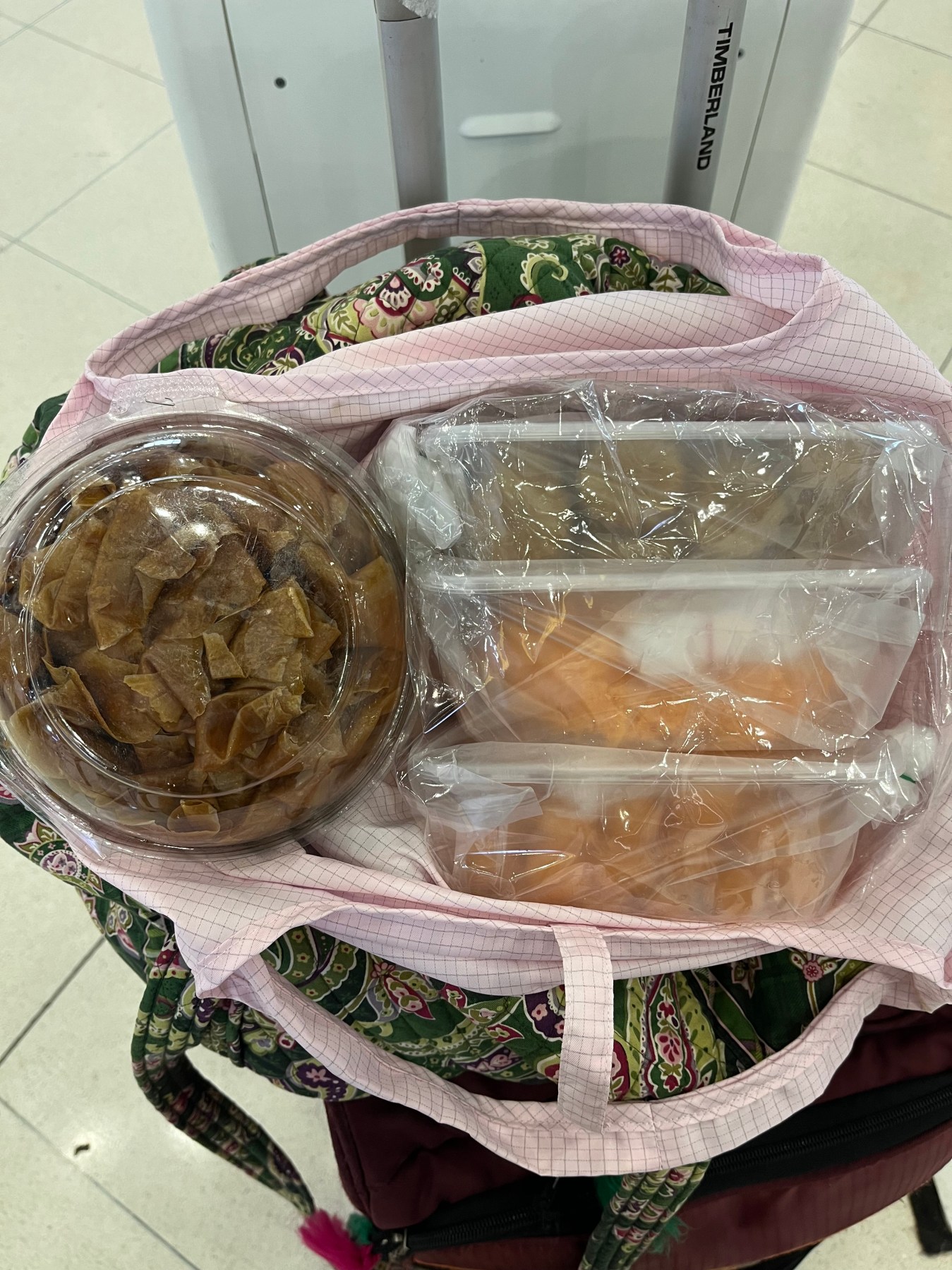
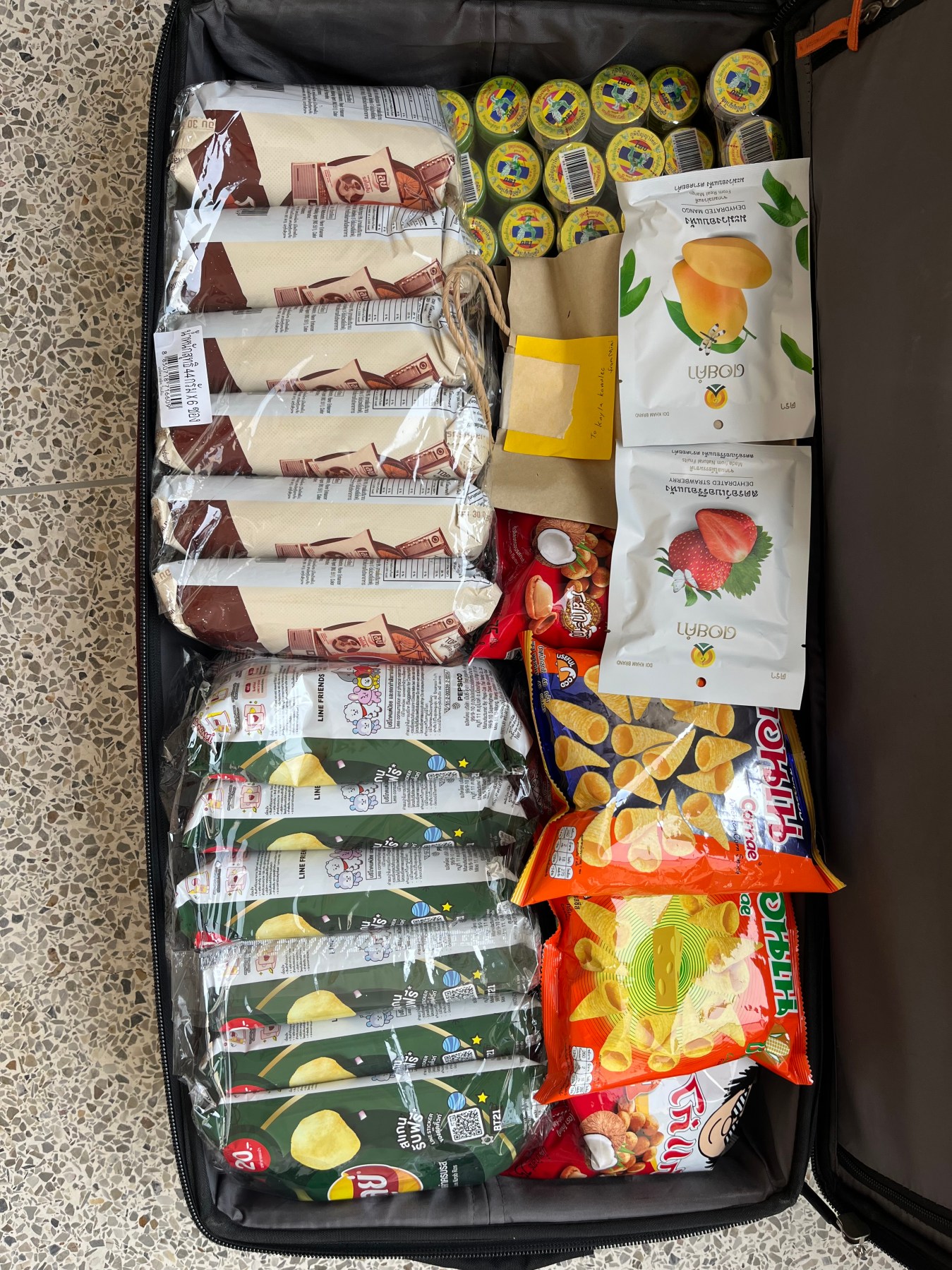
Kanoms. If you’ve ever travelled to Thailand, you’ve definitely eaten a kanom. Kanom is the Thai word for snack and can refer to anything from a sweet treat to Lays chips (a Thai favorite). Kanom-giving/naam jai culture has been written about by Peace Corps Thailand Volunteers many, many, many times, so I won’t get too deep into the lore, but as I’ve written before, the practice resonates deeply with me.
So when I was planning my first trip home in two years between my regular term of service and my additional year as the Peace Corps Thailand Volunteer Leader, I knew I would need to dedicate some serious suitcase space to the Thai kanoms I wanted my friends and family in America to try. For me, it was bigger than which crazy Lays flavor or brand of dried mango to bring back (although significant time and brain power went into each of those considerations). I wasn’t just bringing back snacks, I was bringing back Thai culture. I was consciously advancing the Peace Corps’ Third Goal: “To help promote a better understanding of other peoples on the part of Americans.”
Although nothing should really surprise me after two years of Peace Corps service, it still happens with regularity. I’m incredibly close with my host family from pre-service training in 2020, and went to see them before I left for my home leave. Upon hearing that I’d be heading home to see my American family, my uncle and aunt insisted that they send me with some proper Thai kanoms (aka not anything you could simply buy at a 7-11). They wanted my family to experience hand-made, perishable, must-be-kept-in-overhead-bin-storage kanoms. This meant that my uncle had to drive over an hour to meet me at the airport before my 26-hour flight back west to hand-deliver another bag filled to the brim with kanoms for my family. It meant so much to them that my American family received something from my Thai family.
The naam jai culture is about more than just sharing what you have, it’s about relationship creation and strengthening. It’s about giving time and presence and attention to the ones you love. I filled the entire bottom of my suitcase (and some) with that energy and savored every sweet moment that it created back home.
Kiera Hurley, 135 YinD

This image captures the best part about being a Peace Corps volunteer: spreading world peace and friendship. In this picture with me is one of my best friends from Boulder, Colorado, Allie, who came to visit my community. Surrounding us is a group of my primary 4 students, wielding smiling faces and peace signs. That day, we had the opportunity to share a bit of American culture with the students, while Allie experienced firsthand the warmth, curiosity, and richness of Thai culture. We all were smiling the whole day, and it was so special seeing my two worlds collide.
Laurel Finlay, 136 YinD

The image above captured one of my first a-ha moments at site. It was a beautiful, sunny day, and I was rounding out the final 15 minutes of English Camp with a game of Red Light, Green Light. I remember looking out at the giggling students and feeling for the first time that “I really made it” moment. The sky was a bright blue, with the air quality finally cooperating. The camp had gone well, and I began to trust that I could figure this whole teaching thing out. When I captured this picture, I was so perfectly in the moment. There were no thoughts of home, work, or what I would do next week running through my mind. I was just so happy to be there.
Gretchen Evans, 136 YinD
A screenshot of a group video call is what captures my service best (so far).

You can barely see me, but I am in the bottom right corner of the screenshot mid-laugh. Part of being a volunteer is bonding with your cohort, and those connections you make during PST continue during service. The other part of being a volunteer has only just begun. I am eager to start coaching soccer and teaching life skills regularly!
In the meantime, it is always nice to coordinate calls with friends and family back home, but the elaborate game of phone tag and mental calculations figuring out the time difference can be challenging. However, imagine having a support system in the same time zone. Imagine having people who know what you’re going through. Even the timing of service makes all the difference. Twenty years ago, a PCV in Thailand did not have to experience the community-wide (arguably, worldwide) plague of the doom scroll, nor could they comprehend the brain rot that comes with it!
That is why friendships made here in-country are meaningful. The laughter, tears, and everything in between. I feel so lucky to have met such wonderful individuals through the Peace Corps, and I am looking forward to our future calls!
Alyssa Strong, 135 TESS

May is the month of MANGOES!! And not just any mangoes, but FREE mangoes! What more could a volunteer ask for?
Mango season lasts for a couple of months, usually starting in February, but May has proven to be the time of mango surplus, at least in my small Isaan town.
Last May, I was pleasantly surprised when vendors at my local market had tables upon tables of free mangoes up for grabs. I gratefully grabbed a free bag of mangoes, thinking it was probably a once-in-a-lifetime thing. Flash forward to my second May at site. I was biking home when a stranger on a motorcycle stopped me just to give me a bag of not one, not two, but FIFTEEN MANGOES. The shocked look on my face led him to clarify that they were, in fact, free. So I wobbled home balancing my fifteen mangoes on my bicycle handlebars, recalling that I also received free mangoes around the same time last year, and reasoned that May is simply the month of mangoes, in surplus. As an avid mango-lover, I am in heaven. I just finished eating the last two of the fifteen I received while writing this, so now it’s time to work through the plethora of mangoes from the trees in my yard and at my school!
Michael Swerdlow, 135 YinD

My keychain is not only a keeper of my keys; it is also a keeper of perspective. My keychain represents what I love about my Peace Corps service and Thai culture.
The elephant on my keychain was hand-stitched by a parent of one of my students and given to me as a thank you. Elephants are very sacred in Thai culture and symbolize strength, resiliency, and royalty. Additionally, the coins on my keychain were given to me by our Chinese Teacher during Chinese New Year. They are called Feng Shui coins and are a common gift in Chinese culture to welcome good luck and prosperity into your life, home, etc.
Every time I look at my keychain, I think of the generosity and kindness of Thai culture. I obviously must use my keys multiple times a day to enter/leave my house. Therefore, my keychain is a constant representation of the deep connections and riches I am gaining during my service. My keychain reminds me what the key is to a successful, happy, and fulfilling service (and life in general).
Tucker Strauch, 136 YinD

As a Youth in Development volunteer, the goal of developing life skills in Thai youth can feel abstract. What does growth in confidence or leadership look like? While teaching my first English camp, I began to see how an intangible concept like self-confidence can come to life. Throughout 10 days of leading 40 students in conversational English activities and games, it became clear that even when students had strong English abilities, their confidence in using it, especially with native speakers or in front of their peers, was fragile and lagging. Thus, I organized the camp to review basic conversational English topics, while adding certain activities that served to lightly push the students outside of their comfort zone.
The student pictured above arrived on the first day of English camp and greeted me with a timid wai and a hesitancy to look me in the eye. During the first couple of days, I could tell that his English vocabulary knowledge far surpassed what showed on the surface, but still, every time the ball was passed to him, he got uncomfortable, forgot what he already knew, and responded in just above a whisper. When I organized the camp to culminate in a final project that entailed each student making a poster about themselves and then standing up in front of all of their friends to give a 2-3 minute presentation in English, I was worried that I might be pushing some of the students too far. Instead of building up their confidence in English, I could be putting them in a high-stress situation that would have the exact opposite of the intended effect.
On the last day of camp, it was time to present. I started calling names randomly, until, eventually, it was the boy’s turn to present. He gave his friends a nervous smile before walking up to the front of the classroom. He stood up in front of the whole class and confidently presented his name, his age, where he was from, his family tree, and what foods and activities he liked and didn’t like. I could tell from his anxious fidgets that he was operating outside of his comfort zone, but the pride that was revealed in his face at the end of his presentation told me that the small push was worth it. Life skill development is rarely easy or obvious, but small moments of growth, like this one, provide meaning to my service.
Ella Spear, 136 TESS
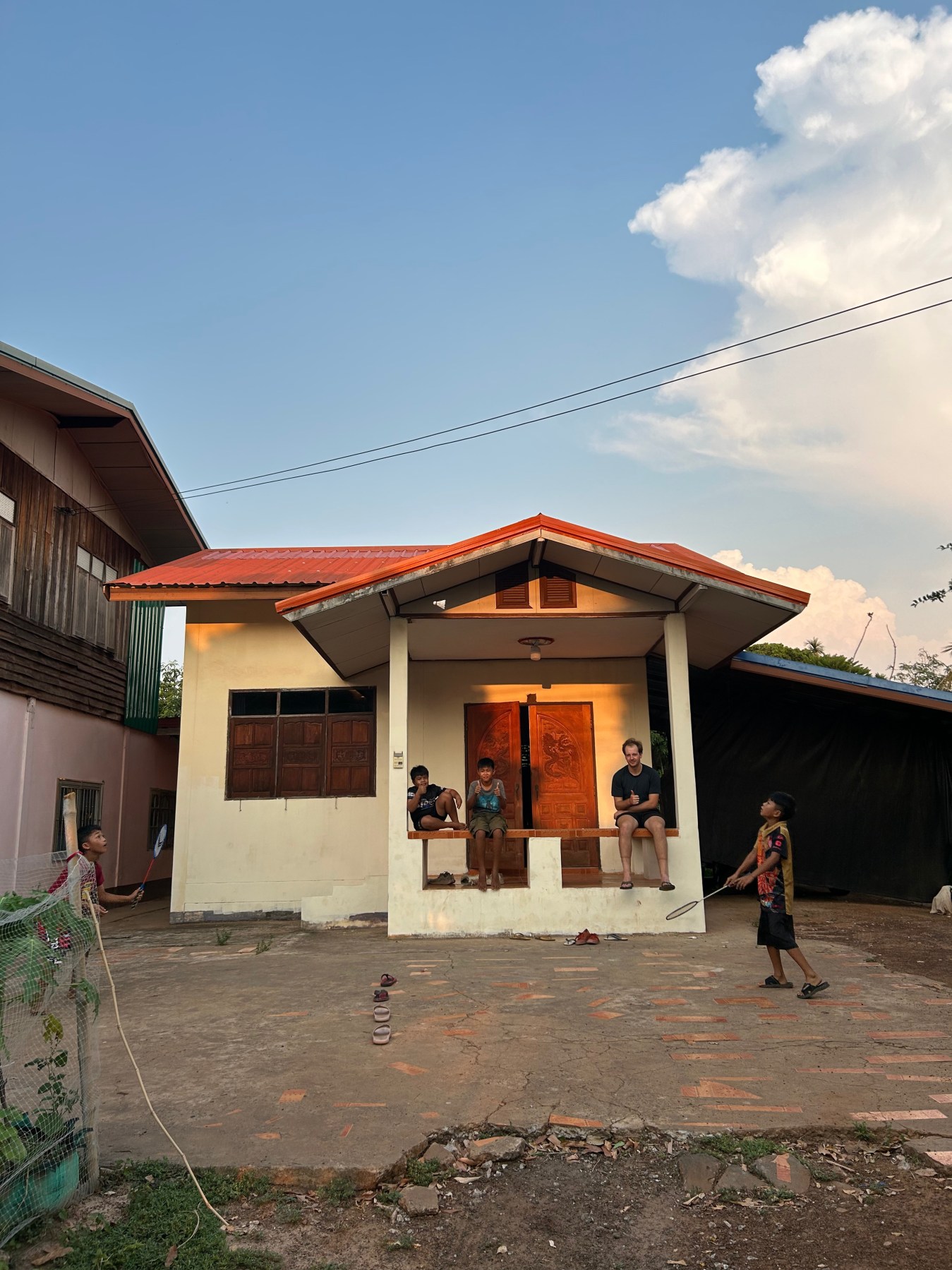
Long before Tucker and I arrived, this had been their playground. Now we are lucky enough to be a part of it. Rolling in on our bikes after work, finding the kids waiting, or hearing the laughter outside during my Thai lesson, we are never alone. The first people to really make me feel at home here were the kids. They began to circle our house on day one, eyeing the new farangs on the porch. One brave high five and hello turned into a flood of new friendships. Looking back, I realize that this was the true beginning of my service.
During summer break, when Tucker and I arrived at site, our afternoons quickly turned into soccer practice. If there was one thing we could count on in the craziness of the first few weeks, it was that at 16:30, there would be a crowd of kids outside with their sneakers and a soccer ball waiting to escort us to the school field. When we started to get busier, the kids adapted. They moved the playground to our driveway, and so ensued a three-week badminton obsession on our makeshift court. Did I always feel like I had the energy to go? Most definitely not, but I have yet to regret that extra hour of “work”.
I am sure almost everyone has a similar story about how their kids make the service meaningful, and it’s already rang true in ways I couldn’t have imagined. After just a week of teaching, I found myself waking up in the middle of the night thinking of activities for my students. I desperately want them to feel seen, to know their time is valuable, and that they deserve consistency and attention. I want to give to them what they have already given to me– a sense of safety, confidence, and purpose. I dedicate my service to them; they make it meaningful, even on the hard days. Now, I am off to play.
Mack Devoto, 135 YinD
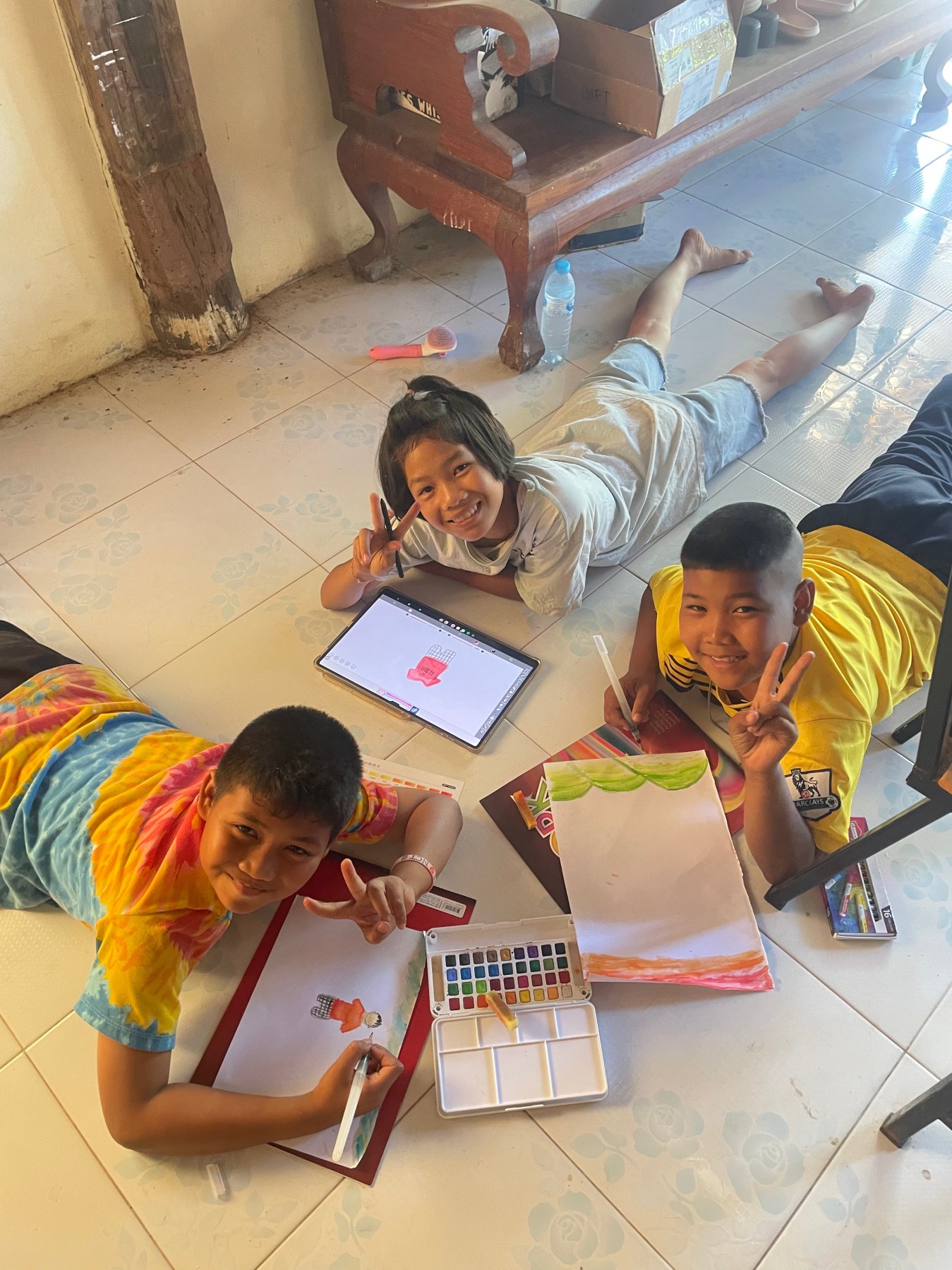
It feels incredibly daunting to try and encapsulate service into a mere photo. There are so many priceless, unpredictable moments that we, volunteers, can’t capture. In my second year, a lot feels familiar, albeit still new. My connections in my community feel stronger than ever, and my home in my tiny neighborhood in rural Isaan has become home for me. The picture that I chose for my ‘Snapshot of Service’ is a simple, but impactful moment I was able to capture that reminds me of how far I have come as a volunteer.
This picture shows three of my students with whom I am quite close. The three of them live in the same neighborhood as me, about a five-minute walk from their school, which is one of the six schools I attend every week. One weekend, earlier this year, after I began taking care of a stray puppy, they asked if they could come over to play with her and hang out for a bit. This then spiraled into an almost weekly weekend hangout at Teacher Mack’s house. Groups of one to five students would come over to my house on a Saturday or Sunday afternoon to play with my puppy, paint, listen to music, make banana bread, or just hang out!
This was a pivotal moment for me in my service. A moment where I realized how deep my integration had become and how proud I should be of my role within the community. There are often moments as a volunteer when you wonder and worry that you aren’t doing enough for your community. You worry that all of the small things you have done won’t add up to any impact in the long run. Then, you share a moment with community members, like this, and remember that sometimes having a positive impact on your community starts with the smallest gestures. Often, these moments may seem minuscule to people like me, who tend to think in the grand picture of things, and it’s good to remind myself of all the seemingly small memories that have left their mark on me. No moment is too small! Every minute here is precious and full of opportunity for connection. These students have taught me so much, as I have taught them. I am grateful for their laughter, smiles, and curiosity that remind me to stay in touch with my childlike wonder.
Kyra O’Connell, 134 TESS
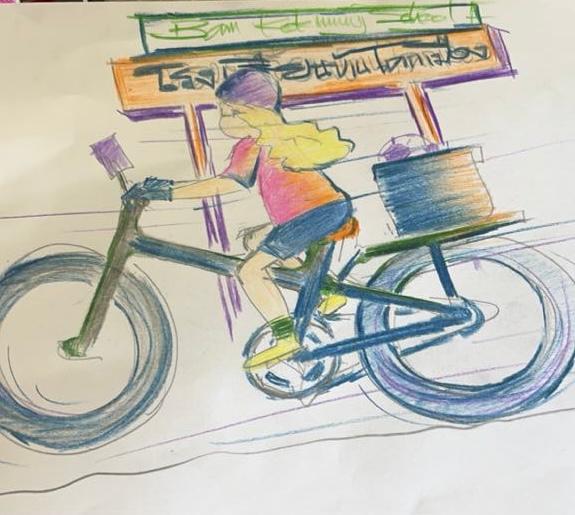
This drawing was done by an art teacher at my school who retired last fall. I don’t know if he thought much of it; he handed it to me in passing, but I’ve kept it ever since. Besides the casual sweet gesture, I think this drawing captures a big part of my service better than any photo ever could.
I ride my bike almost every day at site. Usually to school, but sometimes to the post office, to get a Thai tea, to exercise, to visit a nearby attraction, the list goes on. Sometimes I have someone biking with me, and sometimes I’m alone. Sometimes my students see me and chase after my bike, shouting “Teacher!” and sometimes it’s dogs barking. Sometimes all I’ve got in that basket is a water bottle and a soccer ball, and sometimes it’s a too-big-for-the-basket retirement party gift precariously strapped down with a bungee cord. Sometimes it’s hot, sunny, rainy, foggy, and sometimes I’m happy, tired, excited, anxious, energized, or annoyed.
Riding my bike is a constant at site, and if I were to look at one picture of me on my bike, of which I have collected quite a few, I would fondly remember that particular day. But when I look at this picture, my mind flits through hundreds of little moments throughout my service of being on that bike (which at this point is begging for me to retire it, or at least buy a new bike chain). As time wears on, the specifics of those memories might fade, but the feelings will remain the same, kindly recalled by this drawing.
Holly Lingenfelter, 136 YinD

If you haven’t heard me talk about the 8-year-old girl who practically lived at my host family’s house during training, let me introduce you to Nahleen. She’s the one who threw not just balls but also rocks at me, called me stinky every day, rolled her eyes constantly, and ran away whenever I showed affection. The only photo I have of her smiling is while holding a knife over my face, like a scene straight out of Psycho (I discovered it was a fake knife only after she *play* stabbed me with it).
Nahleen had me worrying about my Peace Corps service before it even started. I thought, “She wants nothing to do with me, and if she doesn’t like me, then none of the kids at my site will.” “How can I be an effective Peace Corps volunteer if the kids don’t like me?”
I tried everything to get her to like me. Occasionally, she’d play with me, usually because her only other options were being alone or on her phone, but most of the time, she wanted nothing to do with me. The harder I tried, the more distant she became.
But the night this photo was taken was the night when things shifted. I was at a loss with Nahleen and feeling defeated. I became an annoying presence because lingering around was better than hiding away in my mind. But it was exhausting. My host dad had Muay Thai blaring from the TV, and Nahleen was glued to her phone. I noticed the sky glowing in a surreal dark pink and purple. I started taking photos, and eventually, Nahleen looked up, noticed, and joined me. We ended up snapping hundreds of photos together, long after the sky turned dark.
Who knew this fierce little girl was into photography? That night was our first real moment of bonding. But the real shift wasn’t in her behavior—it was in mine. I stopped trying to be someone she’d like and started leaning into what genuinely brought me joy.
Kids are intuitive. They know when you’re trying too hard or not being yourself. I’d been trying to fill the shoes of the previous volunteer my family hosted, who set the bar incredibly high (in the best way). But I realized it’s not 8-year-olds who are scary, it’s the vulnerability of showing up fully as yourself, with the risk of being disliked, judged, and ignored.
As Peace Corps Volunteers, we carry constant pressure to be good Americans, good English speakers, and good role models. Expectations come from all directions: Peace Corps staff, communities, host families, schools, and even the children. Add navigating cultural integration to the mix, and it’s easy to fall into an “I should be doing this…” mindset.
But this photo reminds me to fill my cup first. We can’t serve others if our cup is empty. So now, when I’m stuck at yet another community event, I balance the obligation with something that fills up my cup. I get a few puzzled looks while I stretch or do some light yoga, but these small choices have led to genuine moments of connection.
During our final week with our host families, Nahleen was running around in the rice fields and started to take photos of the sky. I watched from a distance, hoping not to ruin the moment, when she turned around to look for me, and with the biggest smile I had ever seen, showed me the photo she had just captured. She was so excited that she took this photo and wanted to share it with me. It only took 9 weeks to feel a genuine bond had been built.
Maybe I wasn’t the first to introduce her to photography, and maybe she’ll never pursue it long-term. But in that moment, I held space for her to express herself creatively, feel pride and recognize encouragement in exploring something new that brings her joy.
So, a reminder to us all that the goal isn’t to be liked, or even to make the next award-winning photographer. The goal is to help kids be themselves, to nurture their confidence, and to model authenticity. Because real connection only happens when we show up as our true selves.
B. Harris, 136 YinD
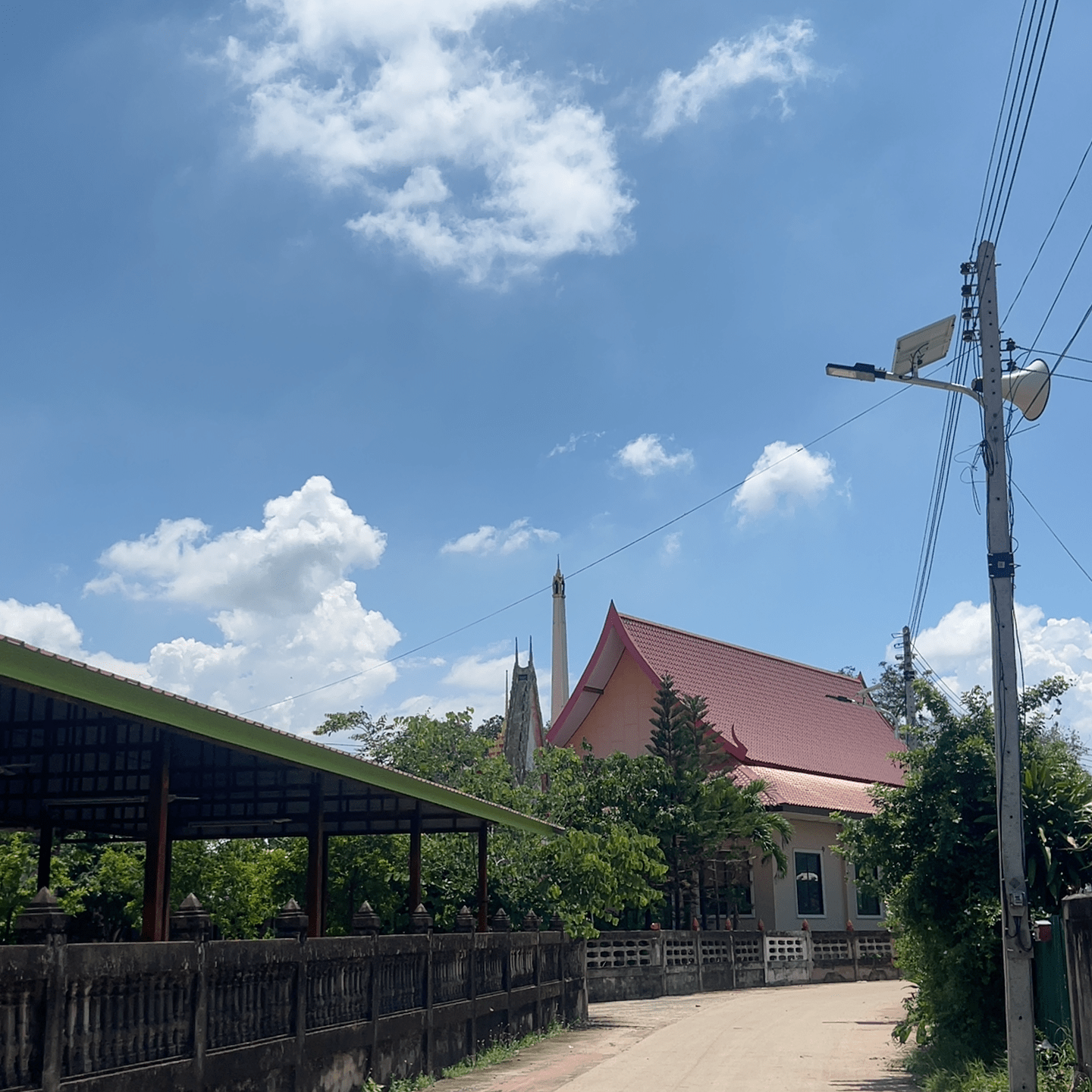
My time at my site has been a daily battle of ups and downs for the first several months. I was aware that it would be challenging for me to adjust to my new environment, particularly now that I was alone. Yet, I decided to be more deliberate about integrating into my neighborhood with activities like yoga, taking walks, and talking with locals every day. Lately, my daily walks have become my favorite. I can stop and chat with people who have always wanted to speak to me but were unable to because I’m riding my bike to work. I also get to discover shortcuts and new streets.
This photo is significant because it was one of my first walks in the neighborhood. The weather was beautiful and the sun was shining brightly, even though it’s the rainy season. And as I took this photo, I was struck by how lovely my community is and how grateful I am to be here.
Lilly Hromadka, 135 TESS
It’s the start of the second school year of my service. I had a beautiful summer break, relaxing, rejuvenating, and not thinking about lesson planning or work in general. Last year our start was shaky because of the newness of it all. Not knowing your school, your students, or the teachers who will be your closest coworkers, one of the most essential parts of your project goal. This year, our start was shaky because of political turmoil back home. Peace Corps as a program was on unstable ground, ground that hasn’t fully stopped shaking, although it’s softened to a slight tremor for now.
As I looked around me back at site, ensconced in clean-up duties, rushed teacher meetings about plans for this year, long admin meetings I didn’t understand, and trying to get my space in order, I worried about the impact on my school, students, and teachers if -god forbid- I suddenly had to leave.
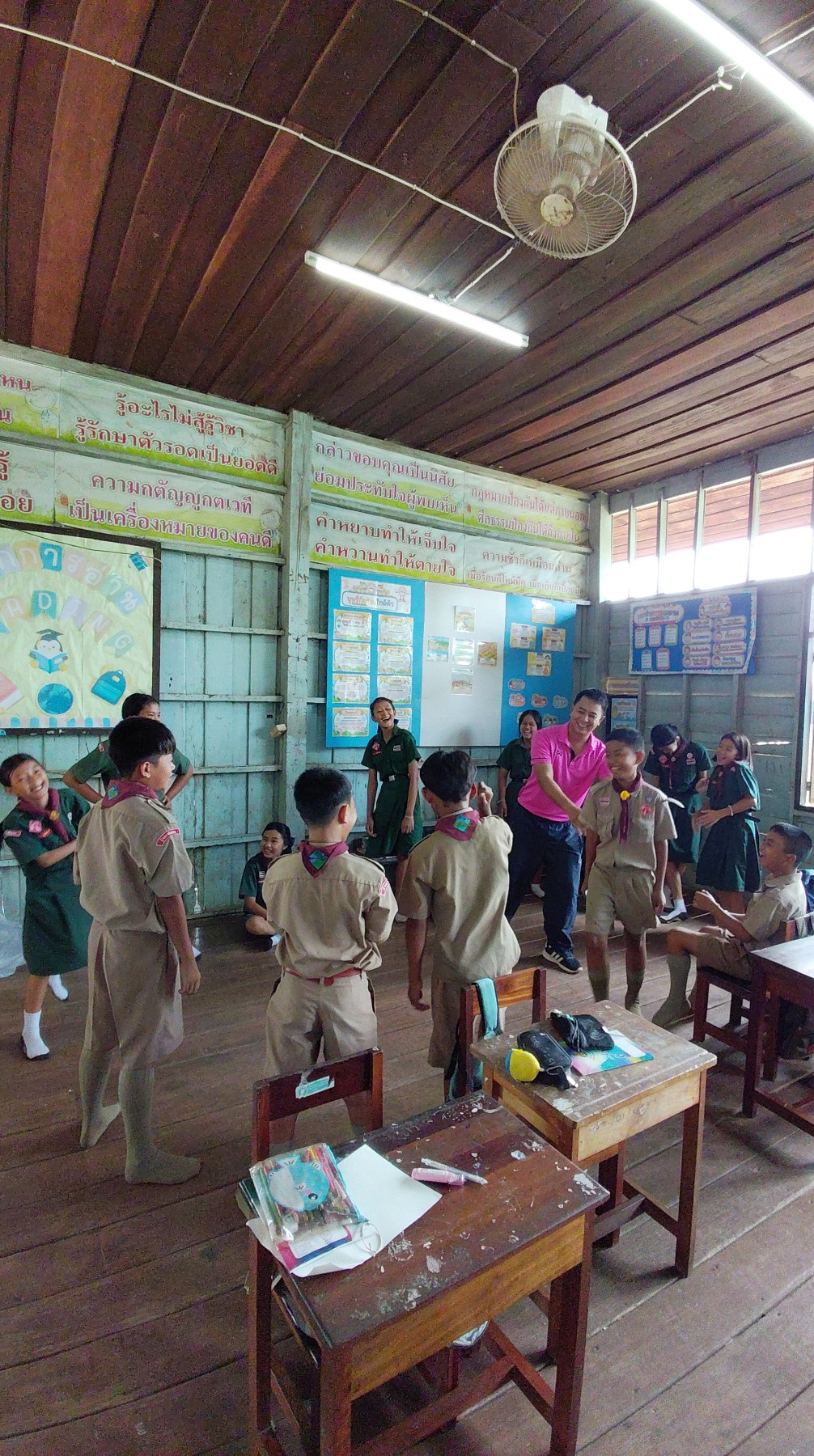
I took this picture on the third day of school. My counterpart for primary 4, 5 and 6 is seen here, laughing with the class at a 6th grade student’s mistake during a game. I’m standing in front of the fan (it was 95 degrees at 9 AM!), off to the side, enjoying the chaos. Teacher Itti watched me play this new game with another class once before jumping in to take the lead. Now on Day 3 it’s his third time playing, and he started without me leading a round first. He did it all on his own. Half Thai, half English. Later on, he took over the lesson too, guiding the review, introducing an activity, and finding new ways to jazz it up that I hadn’t considered, making it uniquely his own. The students were engaged and working hard. Speaking English. I wasn’t needed.
His dedication to the project, to the classroom, to his students, make me glow with pride, and relief. He loves English, although he doesn’t always love to teach. I’m trying hard to find ways to engage him in teaching. He’s trying hard to take up the mantle this year, to practice taking control using the template I set up for him in the first year. And after a year together, I’m elated by his progress so far. Witnessing the enthusiasm of the first week made me realize that, while there is maybe still more work to be done, more I can leave them with, they’re already a success story.
Read more monthly Sticky Rice Staff group articles here.
Check out the Snapshot of Service series here!


 Sticky Rice
Share your thoughts