
Welcome to the “What We’re Listening To” ongoing series where Volunteers talk about the music they’ve been listening to at site. Here you’ll find PCVs sharing their thoughts, reflections, and reviews on music of any genre. Leave us a comment below if you have a take on this music!
Michael Swerdlow, 135 YinD
Music has incredible power to help us describe and experience emotions that can otherwise be impossible to properly articulate. My Peace Corps story would be incomplete without telling how one album in particular influenced my Peace Corps journey. This classic album is regarded as one of the best hip-hop albums of all time and is celebrating its 10th year anniversary this year. The masterpiece I am referring to is, To Pimp a Butterfly, by Kendrick Lamar. The truth is, I could analyze the entirety of To Pimp a Butterfly from its sonic landscapes, interconnected poem, and deep themes. However, I want to focus on a specific song and how it resonated with me: “Momma.”

“Momma” is track 9 of 16 – the midpoint of the album. Up until this point in the album, Kendrick has established the struggles of being a black man in America. He has outlined his struggles with Lucy (the devil inciting him to lose his path and experience emotional turmoil) and Uncle Sam (institutional racism/racial inequality). These struggles have plagued his psyche and stunted his potential. The metaphorical butterfly has been pimped for the wrong purpose: hence the name of the album. Kendrick stated in an interview he liked the juxtaposition of the harsh word ‘pimp’ and beautiful connotations/symbolization of the word ‘butterfly.’ At this point in the album, Kendrick finds himself contemplating how to break free from the clutches of Uncle Sam and Lucy to use his talents for positive change. Open the song “Momma:”
The song begins with the dreamy, soulful sample of Layla Hathaway’s “On Your Own,” putting the listener in a feeling of nostalgic warmth. The fitting sample is about reconnecting with a past love. The selection of this sample will become clear as we dissect “Momma.” Taz Arnold adds some lyrics to begin the intro with:
“I need that / I need that sloppy / that sloppy”
The pronunciation of ‘that sloppy’ is pronounced as an enallage for ‘that sly beat’ self-referencing the songs own musical landscape. These lyrics never fully land on rhythm further emphasizing the ‘sloppy’ beat Kendrick will find himself needing. To me, ‘that sloppy,’ suggests we can still find contentment, even if life can be ‘sloppy.’ Kendrick then begins rapping on verse 1 with the sentiments:
“This feeling is unmatched / this feeling is brought to you by adrenaline and good rap / Black Pendleton ball cap (west, west, west)”
Kendrick opens the verse establishing his identity. He echoes ‘west’ to convey he is in his hometown of Compton, California (the west of America). He continues rapping how Compton shaped his identity throughout verse 1. Compton is his motherland, or the place that birthed, raised, and nurtured him just as a typical mother figure does. This is the first insight we get into the name of the track, “Momma”. Throughout verse 1, Kendrick masterfully adheres to internal rhyme schemes using the hard ‘A’ sound. He also summarizes his path to stardom after growing up in Compton. However, Kendrick closes the verse by acknowledging accomplishments mean nothing without honoring your home:
“I would say it got me a plaque, but what’s better than that? / The fact it brought me back home”
The song then transitions into the melodious chorus:
“we’ve been waiting for you / waiting for you / waiting for you / waiting for you”
The chorus expresses the pull Compton was having on him to return home after all his world tours from his debut album Good Kid, M.A.A.D City. His debut album artfully reveals what it was like for a good kid (Kendrick Lamar) growing up in a mad city (Compton). To Pimp a Butterfly can therefore be delineated as a direct sequel to Good Kid, M.A.A.D. City. After the chorus, Kendrick commences verse 2 with a poetic litany:
“I know everything / I know everything, know myself, I know morality, spirituality, good and bad health / I know fatality might haunt you / I know everything / I know Compton, I know street sh*t, I know sh*t that conscious / … I know wisdom, I know bad religion, I know good karma / I know everything, I know history / I know the universe works mentally / I know the perks of bullsh*t, never meant for me / …. I know loyalty, I know respect, I know those that’s ornery / I know everything, the high, the lows, the groupies, the junkies”
Kendrick expresses all the universal lessons he has accumulated throughout his time in Compton. By repeating the line, ‘I know,’ Kendrick raps a poetic litany for further emphasis of his message. The next line of the verse is one of the most profound statements of the entire album:
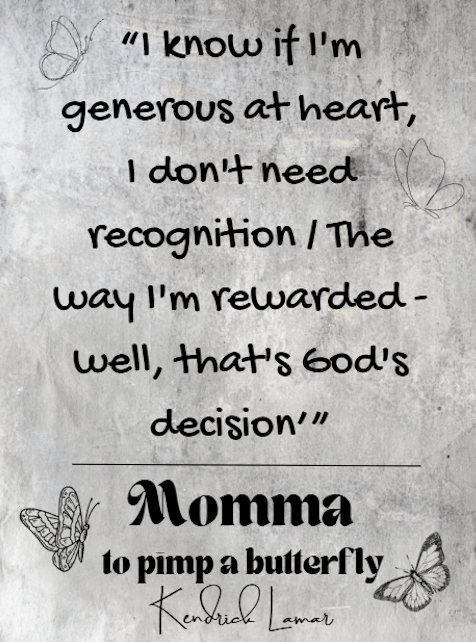
“I know if I’m generous at heart, I don’t need recognition / The way I’m rewarded – well, that’s God’s decision / I know you know that line’s for Compton School District / just give it to the kids, don’t gossip ‘bout how it was distributed”
After such a profound declaration, Kendrick ends verse 2 by negating everything he just imparted in verse 2:
“I know how people work / I know the price of life, I’m knowing how much it’s worth / I know what I know, and I know it well not to ever forget / Until I realized I didn’t know sh*t, the day I came home”
Kendrick acknowledges the trap we can all fall into when we believe we already have all the answers. There is always more to learn, and we never stop growing. What new lesson is Kendrick Lamar about to learn? Open the next reiteration of the chorus:
“we’ve been waiting for you, waiting for you, waiting for you, waiting for you”
This time, the hook’s reputation references Africa calling out to him. Kendrick disclosed in interviews after this album’s release that he took a pivotal trip to Africa before writing this album that heavily influenced its creation. Kendrick will outline how experiencing this new culture and viewpoint opened his eyes to reshape his entire mindset on many songs in this album, including verse 3 of “Momma.” He begins verse 3 by disclosing:
“I met a little boy that resembled my features / nappy afro, gap in his smile, hand-me-down sneakers”
Kendrick further raps on more resemblances he observes between himself and the boy. The boy then directly notices and addresses Kendrick:
“He looked at me and said, “Kendrick, you do know my language / you just forgot because of what public schools had painted”
The young boy acknowledges the language barrier and institutional racism that hindered their initial connection. The boy is likely speaking Zulu (an African language referenced on the song “Complexion (A Zulu love)”. Nevertheless, they are still able to communicate due to a universal connection between them. The verse continues with more dialogue between the boy and Kendrick Lamar about how despite the language barrier, the boy notices Kendrick has lost his way. In the final few lines of the verse, the young boy further addresses Kendrick’s emotional unrest and attempts to enlighten Kendrick:
“I know your life is full of turmoil / spoiled by fantasies of who you are, I feel bad for you / I can attempt to enlighten you without frightening you / If you resist, I’ll back off, go catch a flight or two / but if you pick destiny over rest-in-peace / Then be an advocate, tell your homies, especially / to come back home”
Only if Kendrick is ready to receive the young boy’s guidance, the boy is willing to enlighten Kendrick on the road to self-reform and positive change. Kendrick has been wrestling with how to use his talents for the betterment of mankind rather than the industry attempting to ‘pimp a butterfly.’ The boy is symbolic of the lessons imparted during Kendrick’s trip to Africa. By negating all the universal truths in verse 2, verse 3 challenges Kendrick to reshape his mindset to use his musical influence to support the less fortunate back home in Compton.
By the end of the verse, we see Kendrick at a crossroads of deciding whether to accept the boy’s guidance or not. The line ‘destiny over rest-in peace’ expresses this crossroad of being an inspiration for the world or surrendering to his mental health struggles/celebrity life status. Will the caterpillar shed its cocoon or not? Kendrick often references religion in his music. In his song “How Much a Dollar Cost”, he references Exodus 14 which also applies here. To me, the young boy approaching Kendrick is Kendrick’s burning bush moment.
The song then transitions into an interlude with beautiful saxophones, drums, synths, and the sound of a radio attempting to find a signal. We then hear the echoing lines:
“This is a world premiere”
These echoes and radio signals signify that this song and album can be broadcast worldwide to inspire mankind. Allowing Kendrick to share all the universal truths and becoming an ‘advocate’ for the world. It is a declaration for positive change and optimism for anyone who felt lost. Kendrick then transitions into a twice repeating refrain:
“I’ve been looking for you my whole life, an appetite for the feeling I can barely describe, where you reside? / Is it in a woman, is it in money, or mankind? / … tell me something, think I’m losing my mind, ah!”
Kendrick explains he has been looking for this boy his entire life as it has left him speechless. The song “Momma” is a self-realization track opening Kendrick’s eyes on reprioritizing his aspirations from fleshly desires in ‘woman,’ material procession in ‘money,’ or the betterment of ‘mankind.’ We see Kendrick is ready to listen to the boy and shed his cocoon. Metaphorically, Kendrick has picked ‘destiny’ over ‘rest-in-peace.’
The rest of the album will explore this new road Kendrick finds himself on and how this new road continues to challenge everything he thought he already knew. However, before that, the song then concludes with a frantic outro about how he transitioned from his old life to this new path:
“… Ah, I thought I found you, back in the ghetto / When I was seventeen with the .38 special / maybe you’re in a dollar bill, maybe you’re not real / maybe only the wealthy get to know you feel / maybe I’m paranoid, ha maybe I don’t need you anyway / … I can be your advocate / I can preach for you if you tell me what the matter is”
* * *
Hopefully by now, you can see how and why I connected with this song/album so much.
I felt extreme gratitude for my motherland (Rhode Island) as it taught me all the same universal truths as Kendrick. However, I faced my own challenges (different from Kendrick) that triggered a sense of anxiety. Both of us were then seeking a change in our lives to reach our full potential. Subsequently, we both felt a sense of another place calling out to us, proclaiming, ‘we’ve been waiting for you.’
For me, that place was Thailand. The kids during my service are reflective of the boy Kendrick met while in Africa; regardless of language barriers we are still able to connect and spread love and peace. Lastly, “Momma” falls at the halfway point of the album representing the halfway point of Kendrick and my own story. We are both ready to shed our cocoon and sprout our wings to be an ‘advocate.’ With this new perspective on how it directly affected me, relisten to the song, and see the parallels I was finding on my own journey.
“Momma” is a direct mirror of my journey to self-actualization. Realizing my ‘appetite’ lies in ‘mankind.’ Meaning contentment, happiness, and success comes from spreading love and peace.
I personally love diving into this album and dissecting every track on an individual level and holistic level. The continuous narrative and poem that runs throughout the album is inspirational. The emotional revelation trifecta of “u,” “Alright,” and “i” is cathartic. One of my favorite songs of all time, “How much a Dollar Cost” tells the tale of a transformative experience with a homeless man. The penultimate track “Mortal Man” dives into identity and legacy.
I truly could continue with my adoration and analysis of Kendrick’s entire catalog. They are a masterclass in storytelling and artistic expression. Music has given me a channel to experience emotions and find my identity.
Note: Additional citation goes out to season 1 of the podcast, Dissect, for additional analysis on To Pimp a Butterfly.

 Sticky Rice
Share your thoughts