
The end-of-the-year holiday season, in America and in Thailand, are very different. But one thing is important in each culture: the act of giving. In Thailand, naam jai is the act of giving raised to an almost religious level. This month, we asked the Sticky Rice staff writers to tell us stories of naam jai in their Thai community.
Cloé Fortier-King, 134 YinD
I like to envision naam jai as blood. Not in a macabre way, but as a lifeforce. As the substance that pumps through our hearts, flows through our veins, and serves to remind us that at the most basic elemental level, we’re all the same. If the community in Thailand is a body, then naam jai is the blood, flowing freely between parts, delivering resources, and maintaining homeostasis. It’s a constant cycle of generosity and consideration – as essential and natural as breathing.
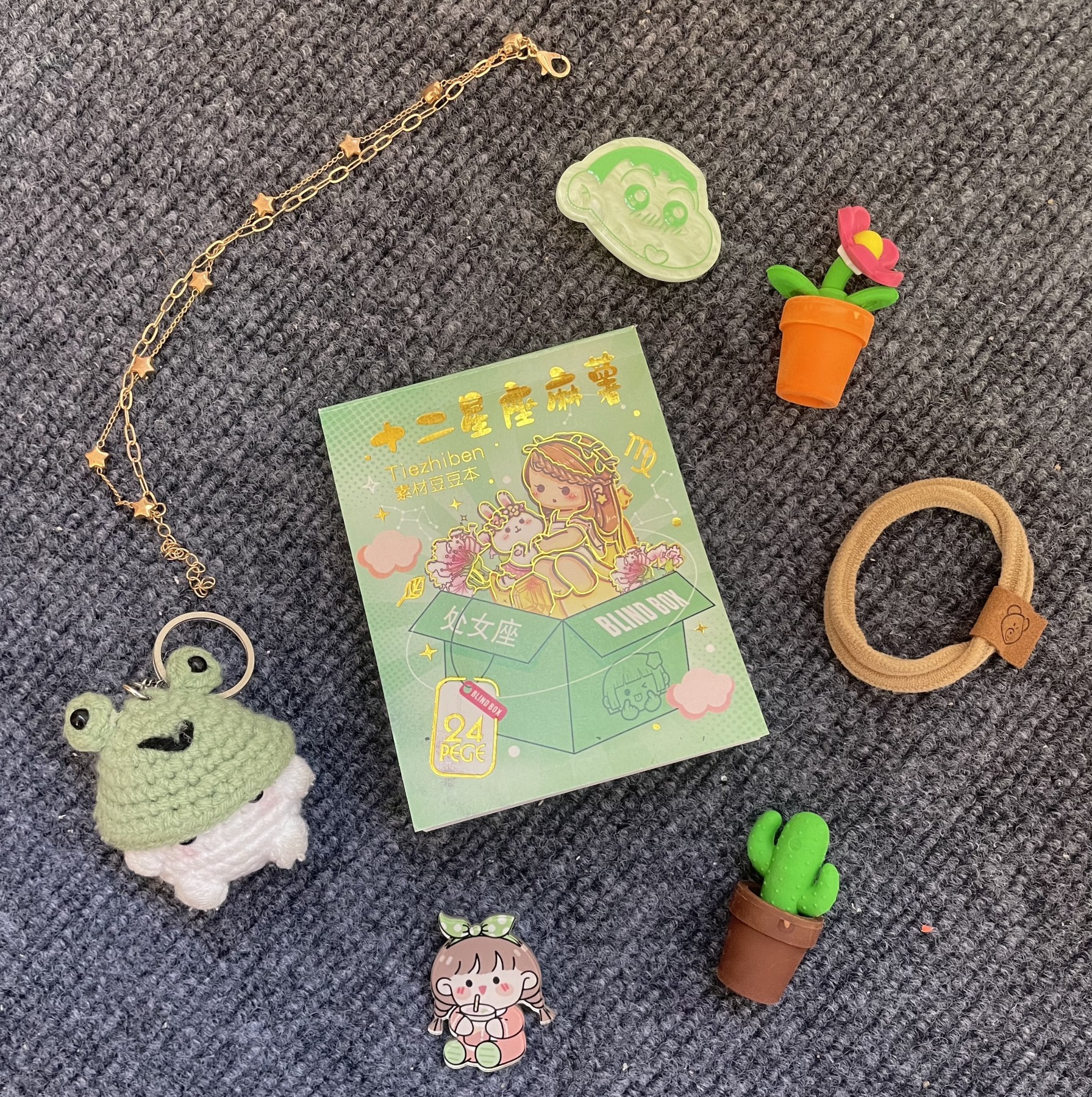
As in any society, the patterns that keep adult life functioning smoothly replicate themselves amongst the youngest citizens, and my students are a perfect example of naam jai in the classroom. Over the course of the last 2 years, they’ve forged a veritable black market of naam jai goods, traversing grade levels and schools. They crowd around me at the beginning of class, pressing their kid currency (candy, hair clips, keychains) into my hands. Once I caught on to this pattern, I proposed a new idea to them: I would make a prize bag that both they and I could contribute to. If a student wants to give me something, they trade it with another item in the bag and never leave empty handed. And when students win games or challenges, they get their pick of goodies. The prize bag travels to several schools each week and provides moments of delight as students clamor to see what new tokens of their peers’ generosity can be found inside. And thus the naam jai blood flows through students and teachers too.
Kiera Hurley, 135 YinD
Naam jai is a concept we were introduced to and experienced early on during our training. It’s almost a way of living here – this concept of giving and receiving to create joy in your own and others lives. Naam jai can be small things such as buying someone a coffee or big things like letting a stranger live in your home for 2 years.
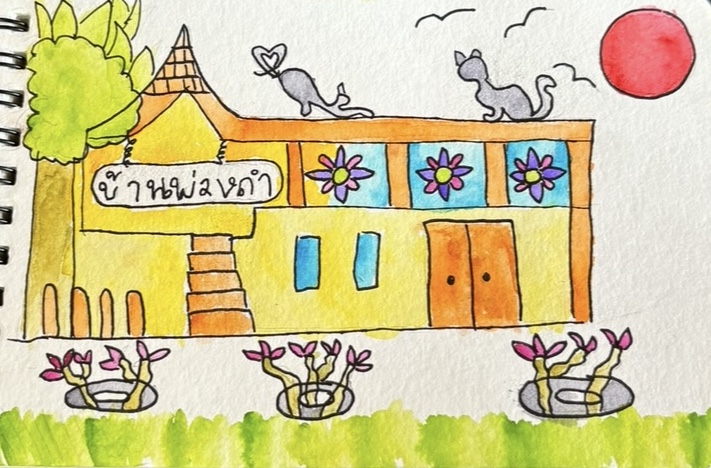
We volunteers quickly learned that showing and providing naam jai was just as if not more important than receiving it. At the end of our training period many of us made cards to thank important people in our lives. We made cards for our language and culture teachers, coffee shop owners, fruit and ice cream sellers, and our host families. Coming together to make these cards was fun for us and in turn so rewarding to see the smiles it brought to people’s faces.
The card that I made for my host family is probably my favorite moment of naam jai I’ve been a provider of. My family’s home is a very special place that holds a calm, grounding energy to it. And my family itself is so amazing and kind so I knew I needed to make a card that would reflect this. I spent a week or so drawing the home my family so graciously allowed me to live in. They not only opened their home to me but their hearts, and I feel this drawing allowed me to provide my naam jai gratitude.
Lilly Hromadka, 135 TESS
The middle of December marked about 9 months at site, and just 6 months of school (not counting the month of school break in October) – around 7 months of knowing my students, all 155 of them. It feels like ages but also no time at all, and the easy hugs and excited greetings I get every day feel as natural as if I’ve been getting them for years. Despite the level of comfort and familiarity we are developing, I feel my breath catch when one of them scampers up to me and enthusiastically offers me whatever snack or candy is clutched in their hand.
There is no instance of naam-jai that stands out so clearly in my mind, and heart, then these near daily occurrences. Offerings of love, from the sixth graders who act more grown than they are, right down to my tiniest first grader. By the end of the day, I’ve usually amassed a small mountain of treats – if they last past the initial hand off! From individually wrapped hard candies and mochi, to rice crackers and bags of chips, if I walk by at the right moment, they’ll even run up to offer me the ice cream they just purchased from the school shop and were clearly planning on eating themselves.
We’re taught in cultural training during PST that food is one of the biggest ways that Thai people express their love and care for you. It’s obvious in the way my host mom cooked massive amounts of food every day (despite it being just the two of us), my co-teacher always pressing some sort of fruit into my hands in the morning, and my Director inviting me for dinner multiple times a month to ask me if I need anything or am comfortable at school.
But the care and appreciation extended by my students, my kiddos, in the small ways they can, spending their pocket money on me, is what means the most. I work every day to show them my appreciation, to thank them for their trust in and respect for me, to offer back all that love and affection in any way I can!
Dano Nissen, 134 TESS
Students arrive at school everyday with some pocket change to buy oodles of kanoms ขนม (treats) from our on campus convenience store. You know how kids are with candy. They stockpile and stand guard like a dragon over their cache. We are all familiar with the “he who cuts shall not choose” method, right? When giving one sweet to share between two children, one child apportions and the other chooses which of the two portions to take. This way, both of their greedy, selfish incentives work together in perfect harmony.
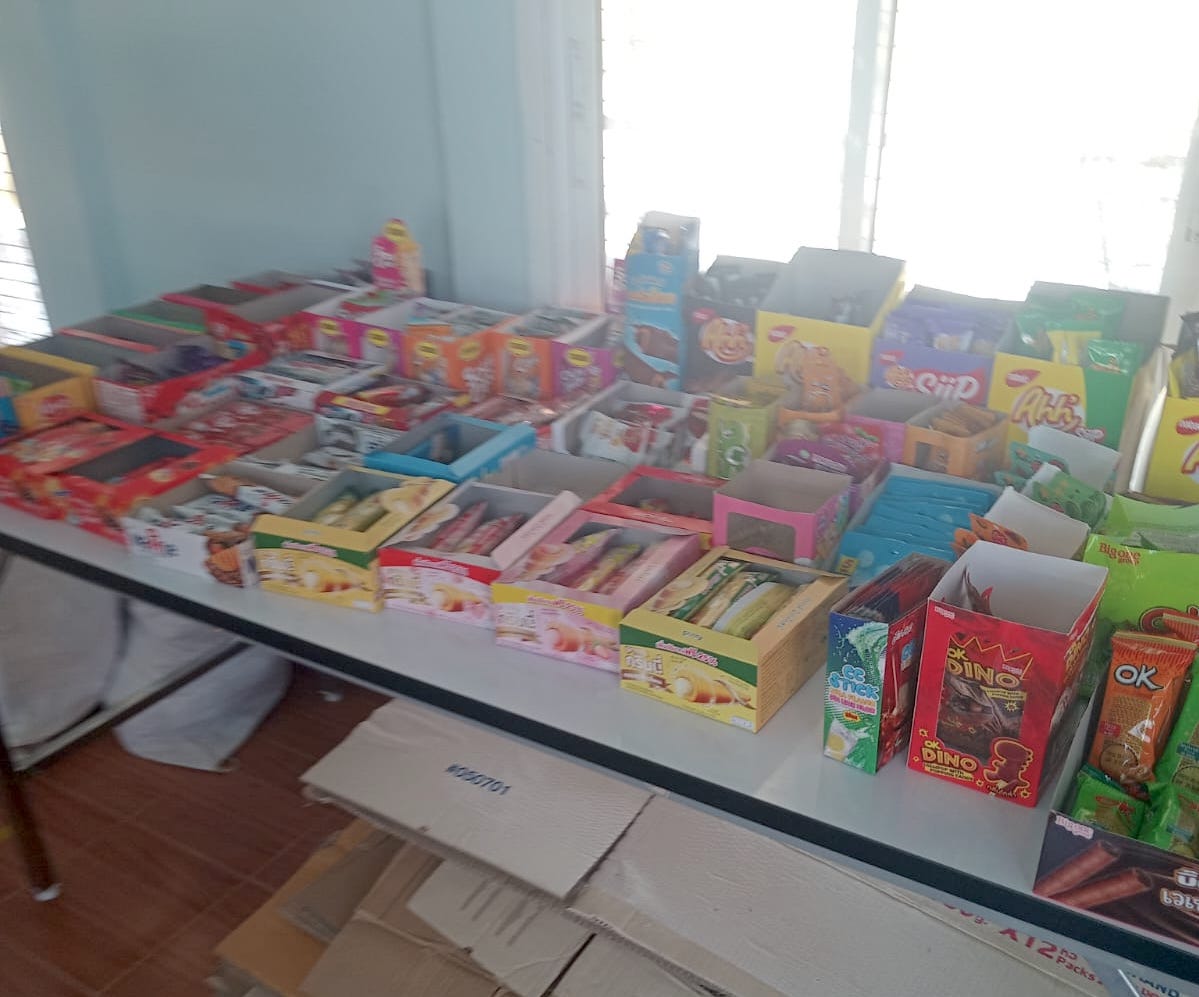
But kids are different at my school. They share candy amongst themselves sans any shrewd bartering tactics; it’s strictly an informal economy of naam jai นำ้ใจ – or in this case, kanom jai ขนมใจ. They run up to me eager to hand me a half eaten chip or a jelly coated in sugar and dirt. I oblige. After lunch, I walk around collecting a potpourri of candy, like I was making the free sample rounds at Costco. Every once in a while someone will reach up to me with their last Oreo or Lays chip or what have you, which, as far as I can tell, is the purest form of kanom jai out there.

Bradford Reszel, 134 TESS
When my counterpart left our school in October, the other teachers knew it would be difficult for me without my friend. While I miss getting to work and laugh with him every day, I have been touched by the many instances of naam-jai my other teachers and directors have shown me. For instance, Cadi and I went to another Volunteer’s English Camp with the plan to take multiple bus trips to get to the school and site. Leading up to the trip, my school director, new co-teacher, and vice director all asked how we were getting there and if they could help. Even though I assured them we could manage the bus, the morning of the trip my vice director (Roong Paw Aw) picked us up and drove us an hour and half to a meeting point where we then met up with the volunteer and her counterpart! So much generosity was greatly appreciated!
I am thankful that my school community thinks of me beyond being a volunteer and native English speaker, they always say we are a family and certainly this recent naam jai experience made me feel it!
Bianca Palese, 134 YinD
One of the most special instances of naam-jai I have received was during PST from my host mom, who I’ve kept in contact with throughout my two year service. She brought me to her friend’s house, who is a tailor, and together they designed a custom dress for me made from this gorgeous purple fabric. I’ve never had clothes tailored before, much less a custom made dress! I look forward to special occasions where I get to pull it out the closet and send a picture to my host mom. I know I’ll keep this dress for the rest of my life, and hopefully pass it on to my kids someday.

Kayla Kawalec, 134 YinD
I’ve experienced so many instances of naam jai while living in Thailand that the practice has become ingrained in me. Generosity in the form of gift-giving, especially gifts of food, is unceasing here. I’ve heard many ideas for why naam jai is so intertwined with Thai culture that they’ve come up with their own dedicated phrase for it. Many point to the collectivist culture common in many Asian countries in which naam jai is a function of sharing what one has with the community. I’ve found a lot of truth in this explanation myself as a beneficiary of many, many acts of naam jai from my community. Lately, though, I’ve been thinking about another lens through which to understand naam jai.
I’m reading Braiding Sweetgrass by the Potawatomi botanist and author Robin Wall Kimmerer, and her words about gift-giving have been living in my head since I read them. She writes about the dichotomy between the indigenous culture of the Native Americans operating in a gift economy as opposed to the colonial culture of the settlers, dependent on the concept of private property.
Kimmerer writes: “From the viewpoint of a private property economy, the ‘gift’ is deemed to be ‘free’ because we obtain it free of charge, at no cost. But in the gift economy, gifts are not free. The essence of the gift is that it creates a set of relationships. The currency of a gift economy is, at its root, reciprocity. In Western thinking, private land is understood to be a ‘bundle of rights,’ whereas in a gift economy property has a ‘bundle of responsibilities’ attached.
The essence of the gift is that it creates a set of relationships.” The phrase unlocked a whole world inside of me that I’d only been poking around the edges of before. I’ve always tried to follow the Southern advice from a dear family friend from Mississippi who “never returns borrowed Tupperware empty.” Whenever I experience naam jai from members of my community, I try to “return the Tupperware full.” My relationships have been strengthened from it. I also try to put into practice a lesson I learned from my Mom and Grammy, to be a gracious receiver. In Thailand, reciprocating often leads to even more gifts and food and thoughtful acts in return. I learned early on that my Thai friends and neighbors are the naam jai masters and I am merely an apprentice. Sometimes it’s best to just graciously accept a gift and admit defeat.

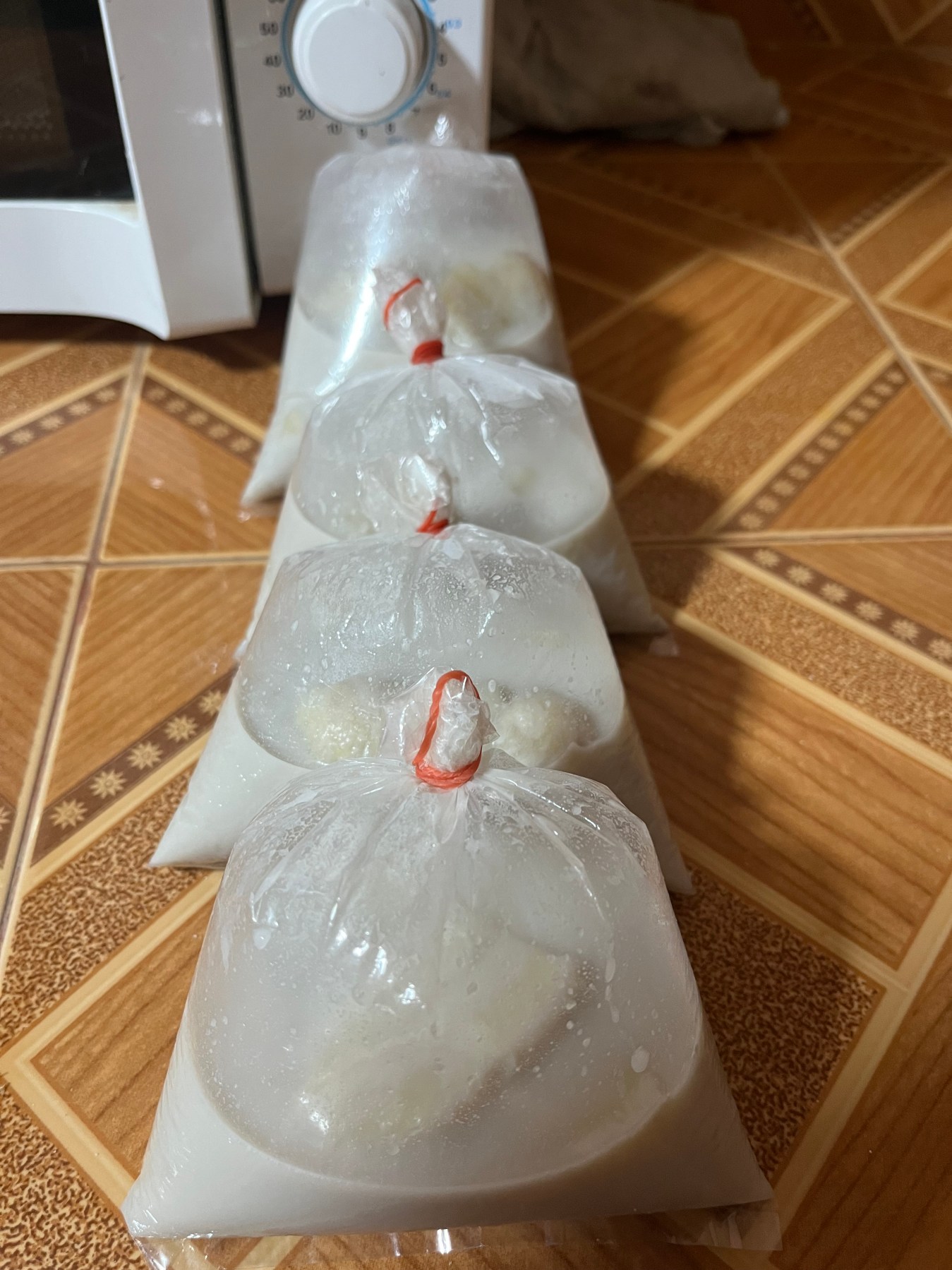
My neighbor is one of the most prolific gift-givers I know. I wrote about some of the things I’ve received from him in my Ode to my Thai home. My friends, family, and Thai tutor have all come to expect that if we’re talking on the phone in the evening there’s a high chance we’ll be interrupted by a drive-by act of naam jai. He, and sometimes his wife, on their motorcycle or in their giant, loud rot ee-dten (basically a huge cobbled together truck powered by an oversized tractor engine that sits square in the middle of the cab), will stop by most evenings on their way to or from their farm to gift me all sorts of things. It’s so frequent that I’m now able to identify the sound of his specific vehicle down the road even though dozens pass in front of my house daily. The “problem” with these gifts is that I live alone and can only eat so many bananas, cucumbers, and sweet little river crabs; the “solution” is that my neighbor’s naam jai can be spread so far with just a little extra work and ingenuity from me. Recently I took 20-plus bananas and made Thai desserts to share with friends, coworkers, and of course to “return the Tupperware full” to my neighbor as well.
The cycle, of course, then starts anew, its perpetual motion a constant in my life here.


Alyssa Strong, 135 TESS
Thai people are so genuine and kind that I have endless experiences of naam jai. I’m constantly given food – receiving fruit might be my number one love language. I’ve also been gifted clothes, household appliances, jewelry, stickers, drawings, and more. People from my counterparts to complete strangers have dropped everything to give me rides. A random shop I found on the side of the road fixed my phone that I was convinced was never coming back to life not once, but twice, and both times for free. Whenever I think all hope is lost, my community’s naam jai pulls me back onto my feet and saves the day.
I’m grateful to experience little gifts of naam jai almost daily. Yet the ultimate experience of naam jai in my service so far was from the people in a little village on the other side of my site’s standalone hill. My counterpart took me to a new cafe in the village on a rainy Saturday to try their Pad Thai (something that is surprisingly difficult to find in my town). I don’t recall having a conversation with the owner while eating there, but a couple days after we stopped at the cafe, my counterpart mentioned that the owner of the cafe wanted to “take me somewhere.” The wording of that statement sounded a little concerning, but I had my friend (Angie) visiting at the time and a teacher from my school accompanying us as well.
The next weekend, I got a text out of the blue saying, “I’m going to take you to the cafe today,” so Angie and I rushed home to embark on the spontaneous adventure. Upon arrival, we were greeted by the owners, a local tutor they invited to be an English translator, and the sweetest group of children from the village. They immediately gifted Angie and me beautiful handcrafted bags from a local seamstress, then took us on a sunset drive around the village, where we met the seamstress who made our bags. She showed us the tedious process that goes into making some of the most beautiful and expensive clothing and accessories in Thailand. Our exclusive tour also stopped at the symbol of the village, a heart-shaped tree standing alone in the middle of a field. It represents the people of the village and the genuine love they share with others. The grand tour ended at the cafe where we were served just about every item on the menu. Our first course was the Pad Thai that Angie and I loved on our initial visit followed by many other local dishes, beer that never stopped flowing, and snacks to take home. When we were stuffed beyond our heart’s content, the cherry on top was when the staff brought out หมูกระทะ (moo grata) or the famous Korean BBQ/Chinese hot pot fusion. They truly pulled out all of the stops and provided my friend and me with the utmost hospitality and generosity, expecting nothing in return.
The people in this tiny village that could have hidden tucked away on the side of the hill I don’t go to often are now a second home. They give me so many reasons to frequent the other side of the hill. A side of the hill I never would have touched if the people there had never welcomed me with so much naam jai. The generosity of Thai people is beyond explanation. It is one of those things that you just have to come to Thailand to experience for yourself.



 Sticky Rice
Share your thoughts